Does a break room change anything for hiring and keeping people?
Not on its own. A vending machine does not keep anybody in a job, and the claim that it does cannot be shown to you. What a break room can do is smaller and more honest: it removes one daily friction, the shift where the only choices are leaving the site or going without. That is worth fixing on its own terms, and it is visible on a hiring tour.
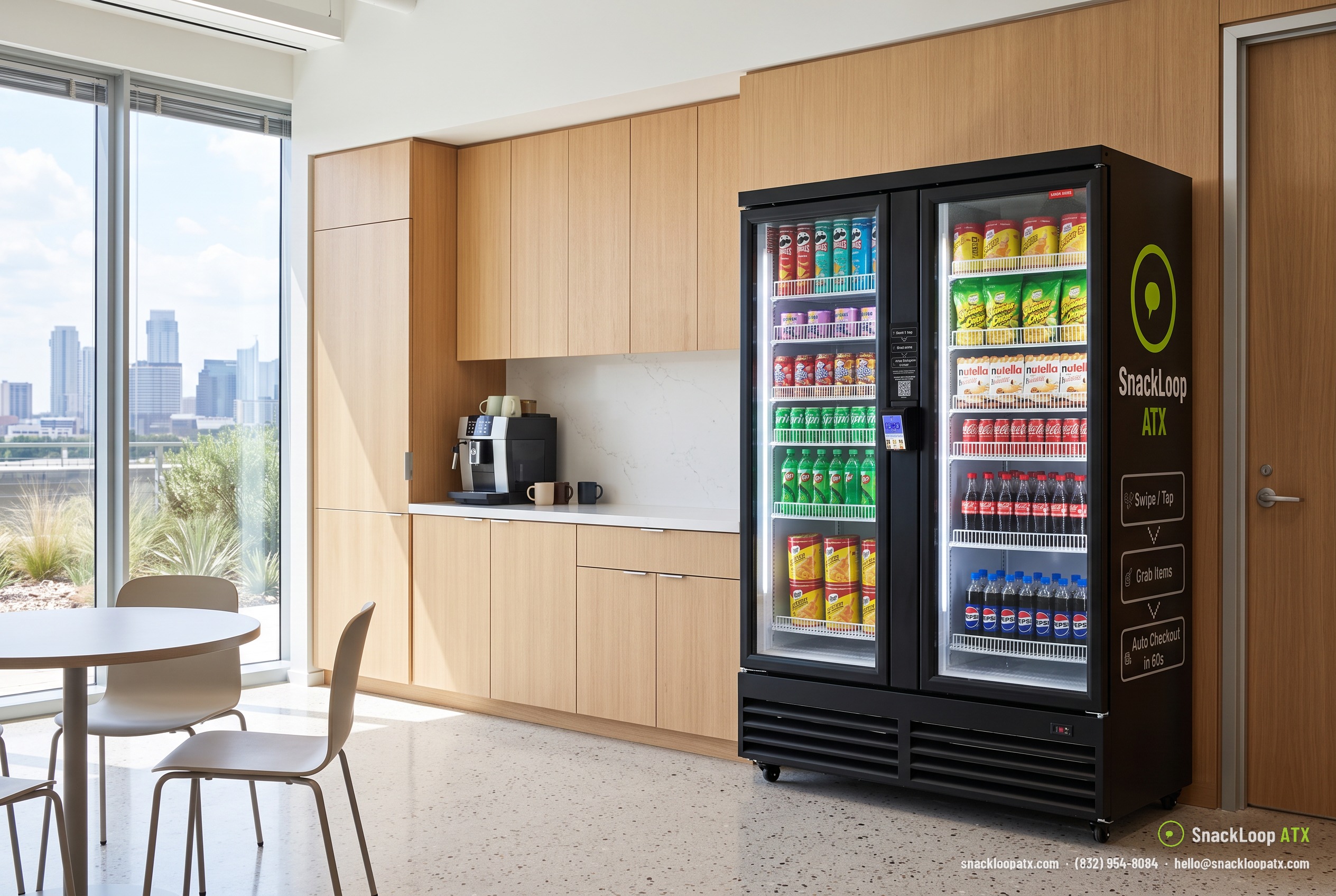
A vending machine does not retain anybody. Nobody can show you that anything in a break room does.
If somebody has told you that a snack machine helps you keep people, that claim cannot be shown to you. This page argues something smaller, because the smaller argument survives being checked.
What friction are we actually talking about?
A shift where the only two options are leaving the site or going without.
That is the whole of it. Somebody gets hungry partway through the day. They can leave the building, which costs time they may not have, or wait it out. Neither is a crisis. Both are minor. The only interesting thing about minor is that it repeats.
Notice what is not being claimed. Not that this makes anybody quit, and not that removing it makes anybody stay. Only that the friction is there, that it is easy to check, and that it is cheap to remove.
Where does that friction weigh most?
Wherever leaving is hardest.
That is a different question from where the most people are. An office across the street from a coffee shop has almost none of that friction: somebody stands up and walks out. Now picture a warehouse floor with a fixed break, a service bay with a car up on the lift, a clinic running appointments back to back. Leaving costs something there, and crossing a parking lot in an Austin August costs more in the warehouses out toward Pflugerville than in an office suite downtown.
Which case your building is, you can see. Look on the hardest shift, not the easiest.
| What to look at on the hardest shift | The question it answers |
|---|---|
| Whether somebody can leave and be back inside a break | Is going out real, or theoretical? |
| The nearest place to buy a cold drink, walked and timed | Is there already an easy alternative? |
| Whether it is open at the hour this shift runs | Does the alternative exist at night too? |
| Who is furthest from the door | Which group carries the friction, and is it the one you are hiring for? |
| What people bring in, and what they do when they forget | Is this already being solved without you? |
Nothing in that table is a result. Every line is something you can observe in your own building.
What does a candidate see when you walk them through?
The break room, because it is on the route.
Ask yourself which rooms on that route got tidied for the visit, and whether the break room was one of them. It is often the room nobody staged, which is what makes it worth a second look. It shows the building on an ordinary day.
What a candidate concludes from that we cannot tell you, and anybody who claims to know is guessing. What is checkable is duller: the room is on the tour. So walk the route yourself and look at that room as somebody seeing it for the first time.
What does it cost you to fix?
Nothing to install, and that is the actual argument.
SnackLoop ATX delivers and installs the machine, stocks it, restocks it on a regular schedule, and services and repairs it at our own cost. The machine and everything in it stay ours until somebody pays. You provide floor space and a standard power outlet. Nobody on your side orders product or counts inventory. Payment is a card or contactless tap with automatic checkout in about 60 seconds, and there is no cash, no coin mechanism and no keypad codes.
Placement terms vary by location and are agreed before installation, and there is no long-term lock-in.
One thing to be plain about, because the word free gets stretched. This is not free food. The installation costs you nothing. The snacks are paid for by whoever takes them. If you want food provided at your expense, that is catering, and a different conversation.
That is why a break room sits on the list of cheap things rather than the big ones. Most of what could go on the same list costs money or a policy change. This costs a corner and an outlet. If you would like us to look at the space, the application form takes about a minute.
When is the break room not the problem?
When people are leaving over pay, hours or a manager.
If people are leaving over pay, hours or a manager, the break room is not the problem, and fixing the break room will not hide it. That is the limit of this whole argument, and it is better said here than discovered after an installation.
A machine cannot change what a job pays. It cannot make a schedule livable. It cannot do anything about a supervisor people would rather avoid. If one of those is the live issue in your building, a break room improvement is at best a small good thing beside a large unresolved one, and at worst it reads as a serious complaint answered with a snack.
So the order matters. Deal with the thing people name out loud first. A break room is worth doing when it is one of the small things left, not a substitute for a bigger one.
How do you judge this for yourself?
Ask the people on the hardest shift what they do when they get hungry.
Not a survey. One question, put to the people furthest from the door, on the shift where leaving is hardest, in the words they would use themselves. You will probably hear one of a handful of things. They bring something in. They go without. They drive out and come back late. One person makes a run for everybody.
Whatever you hear is worth more than this page, because it is about your building. If nobody has a problem, you have saved yourself an installation. If people go without, you now know the size of the thing.
And if the answer is that there is already a machine and people gave up on it, that is a different problem with a different fix, covered in switching vending providers without a gap in service.
Frequently asked questions
Will a vending machine help us keep staff?
No, and we will not tell you it does. Nobody can show you that a snack machine changed who stayed in a job, because too much else moves at the same time. What it does is remove one friction on one shift.
Is the food free for our employees?
No. The installation is free to you. We supply, install, stock and service the machine at our own cost. The food is not free to the people who take it. They pay at the machine by card or contactless tap, the same as anywhere else.
Our people can walk to plenty of places. Does this still make sense?
Possibly not, and that is a reasonable answer. Where an easy alternative sits a short walk away, most of the friction is already gone. The case is strongest where leaving is hard: a fixed break, a floor somebody cannot step off, an hour when nothing nearby is open.
What do we have to provide, and what happens if it breaks?
Floor space and a standard power outlet. We deliver, install, stock, restock on a regular schedule, and service and repair the machine at our own cost. If it develops a fault, that is our cost to carry. The machine and its stock stay ours until somebody pays.
What if we install one and nobody uses it?
Then it was the wrong room, the wrong spot in the room, or the wrong building, and none of that costs you equipment. There is no long-term lock-in, so the machine can move or come out. A machine nobody walks to is worse than none.