How much space does a vending machine need?
The footprint is the smallest part of the answer. What actually stops an installation is the route to the spot: a door the machine will not pass, a turn in a corridor, a step with no ramp. After that comes the wall it stands against, then an outlet within reach that is free rather than borrowed. Ask us for the exact figures on the model, and we will walk the route with you.
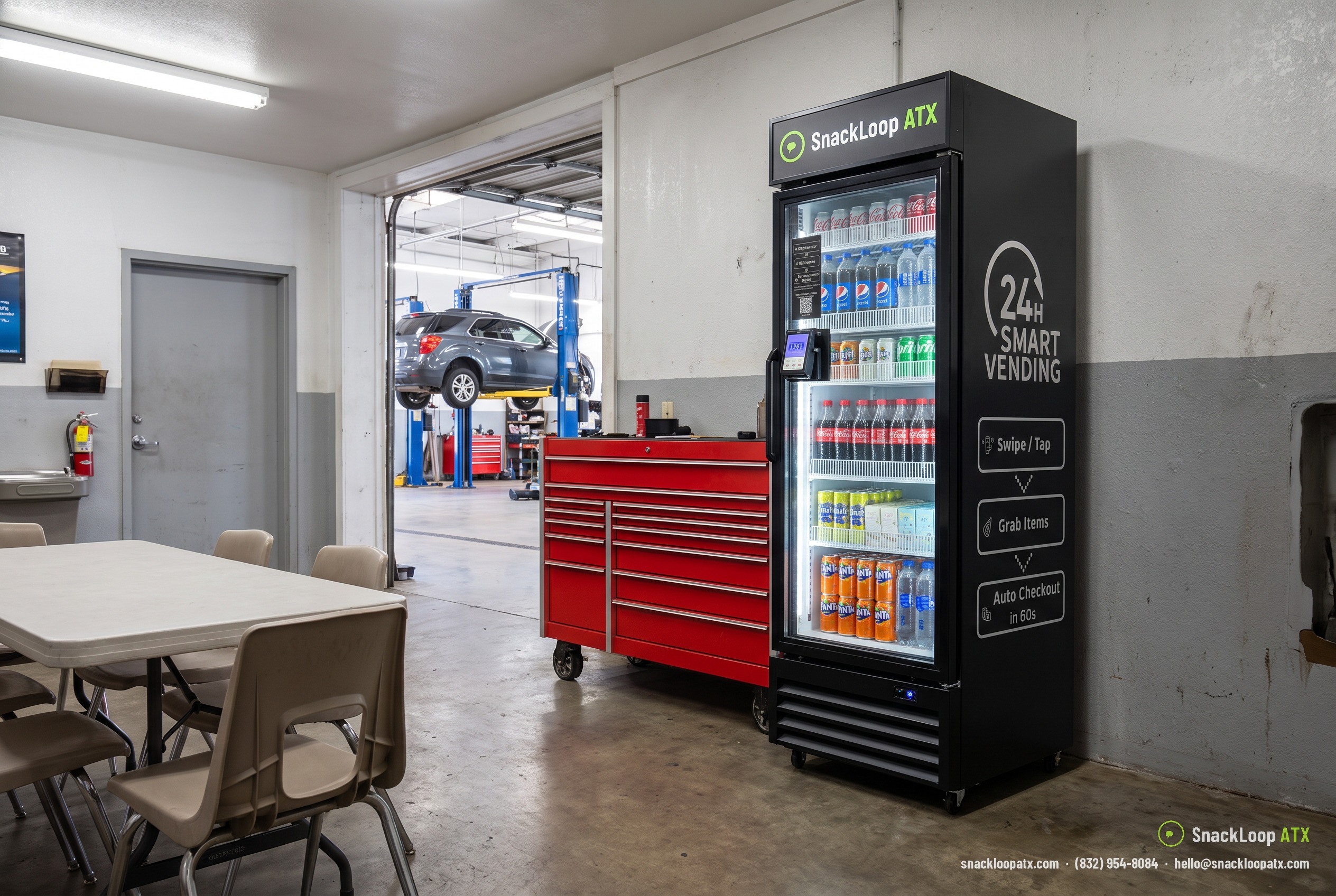
Start with the floor if you like. It is the easiest part to settle and the least likely to decide anything.
Is the floor space really what decides it?
Rarely. A machine that fits the corner perfectly still has to reach it, and the corner is the last step of the job rather than the first.
There is a second reason the floor is a weak place to start: a vending machine is not one size. A slim drinks cooler is a different appliance from a full snack and drink combo, and it goes into rooms a combo does not. Before ruling a room out, ask which machine it was ruled out against. The machine gets chosen to fit the room.
We will not print dimensions here, and be wary of any article that does. A figure wrong by a little is worse than none at all, because somebody clears a space and the delivery still fails. Ask us for the figures on the actual model.
What can stop the machine reaching the spot?
The way in. That is what can turn a scheduled installation into a wasted morning, and it is not the room at the end of it.
Walk the path the machine would take, from where a truck can stop to where it would stand, and look at it as an object that does not bend or fold. Every door on the way, not only the entrance. The turn where one corridor meets another, because a corner asks for more room than either hallway suggests. A step at a threshold with no ramp. An elevator, if the spot is not on the floor the truck can reach.
An older building is where the route is worth walking twice. A converted storefront in East Austin with a step up from the sidewalk and a narrow back hallway can be a harder job than a warehouse out toward Round Rock with a roll up door. The route tells you far more than the size of the building.
Why does a machine need a wall behind it?
Because it has to stand against something. It is tall and heavy, people pull at it and lean on it, and the back of it is not a display side. A spot in the middle of a room is not a placement, however much floor is going spare there.
That rules out the far side of a glass partition, a movable divider in an open plan office, the middle of a wide lobby. Which walls work is a question only your building can answer, from door swings to how people leave in a hurry.
What about the outlet it plugs into?
A standard power outlet within reach of the spot, free rather than borrowed.
The circuit it sits on is where breakrooms catch people out. A corner that looks empty may be the corner where the fridge, the microwave and the coffee maker already live, because that is where the sockets are. Whether that circuit has room for one more appliance is a question for whoever knows your panel, so ask us for the rated power draw and put it in front of your own electrician.
An extension cord across a walkway is a trip hazard rather than a fix.
Why is a quiet corner a worse spot than an awkward one on the route?
Because a machine sells to people who walk past it, and nobody walks past a store cupboard.
If the tidiest spot in the building is a back corridor, a storage room or a landing nobody crosses, it solves your problem, which is where to put the thing, and creates another: a machine that has to be remembered gets forgotten.
So a slightly awkward spot on the route people already take beats a perfect one they do not: near where the shift breaks, near where customers wait, on the way out to the parking lot. And before ruling out the tight wall by the door everyone uses, ask whether it is tight for the machine we would put there.
What should you check before you call anyone?
Nothing that needs a tape measure. Walk it once with the person who knows the building.
| What to look at | Why it matters |
|---|---|
| The path from where a truck can stop to the spot | If the machine cannot get there, nothing else on this list matters. |
| Every doorway on it, not just the first | A generous front entrance says nothing about the breakroom door. |
| The turn where two corridors meet | A corner asks for more room than either hallway suggests. |
| A step or threshold with no ramp | A small rise is a real obstacle for something heavy on a dolly. |
| A solid wall at the spot itself | Glass and movable dividers do not count. |
| The nearest outlet, and what shares it | Standard, in reach, free rather than borrowed. What else is on that circuit is worth asking your electrician about. |
| Whether anyone actually passes the spot | A spot chosen for tidiness is a spot chosen against traffic. |
Then let us come and look. A site visit is where this gets decided: we bring the figures for the model and can see the route instead of picturing it. If the spot does not work, we would rather say so at your building than send a truck to find out.
SnackLoop ATX delivers and installs the machine, stocks it, restocks it on a regular schedule, and services and repairs it at our own cost. What you provide is floor space and a standard power outlet. Every purchase is a card or contactless tap, with no cash, no coin mechanism and no keypad codes, and checkout completes automatically in about 60 seconds. Placement terms depend on the location and are agreed before installation, and there is no long-term lock-in. If you want us to look at your space, tell us where you are and what the room looks like.
And if a machine already stands in the worst corner of your building, the spot is worth revisiting along with the rest of the arrangement. We wrote separately about changing vending providers without a gap in service.
Frequently asked questions
How much space does a vending machine actually take up?
It depends on the model, which is why we will not print a figure here. A wrong number in an article becomes a wrong installation: somebody clears a space that turns out to be the wrong one. Ask us for the measurements of the machine that would go in your building.
What actually stops an installation?
Getting the machine to the spot, rather than the spot itself. A doorway it will not pass, a turn where one corridor meets another, a step with no ramp, an elevator out of service. All of that is easy to look at in advance and expensive to discover on delivery day.
Can the machine stand in the middle of a room or in front of a window?
No. It goes with its back against a solid wall, so a spot marooned in the open is not a placement, and a window, a glass partition or a movable divider is not a wall. Which wall works also depends on door swings and walkways in your own building.
My breakroom is small. Does that rule us out?
Not by itself. A slim drinks cooler is a different appliance from a full snack and drink combo, and it suits rooms a combo does not. If a room has been ruled out as too small, the question worth asking is which machine it was ruled out against.
Do I need to measure anything before I contact you?
No. Walk the route the machine would take, from where a truck can stop to where it would stand, and note anything narrow, tight or stepped. Tell us what you saw. We bring the figures for the model to the site visit.