What to ask a vending company before you sign anything
Ask who owns the machine, who pays when it breaks, how often it gets restocked, what happens if the product mix is wrong, how the placement ends and who picks up the phone. None of those are trick questions. The reason they work is that a good operator answers each one in a sentence, and a bad one gets vague instead. The vagueness is the signal you are actually testing for.
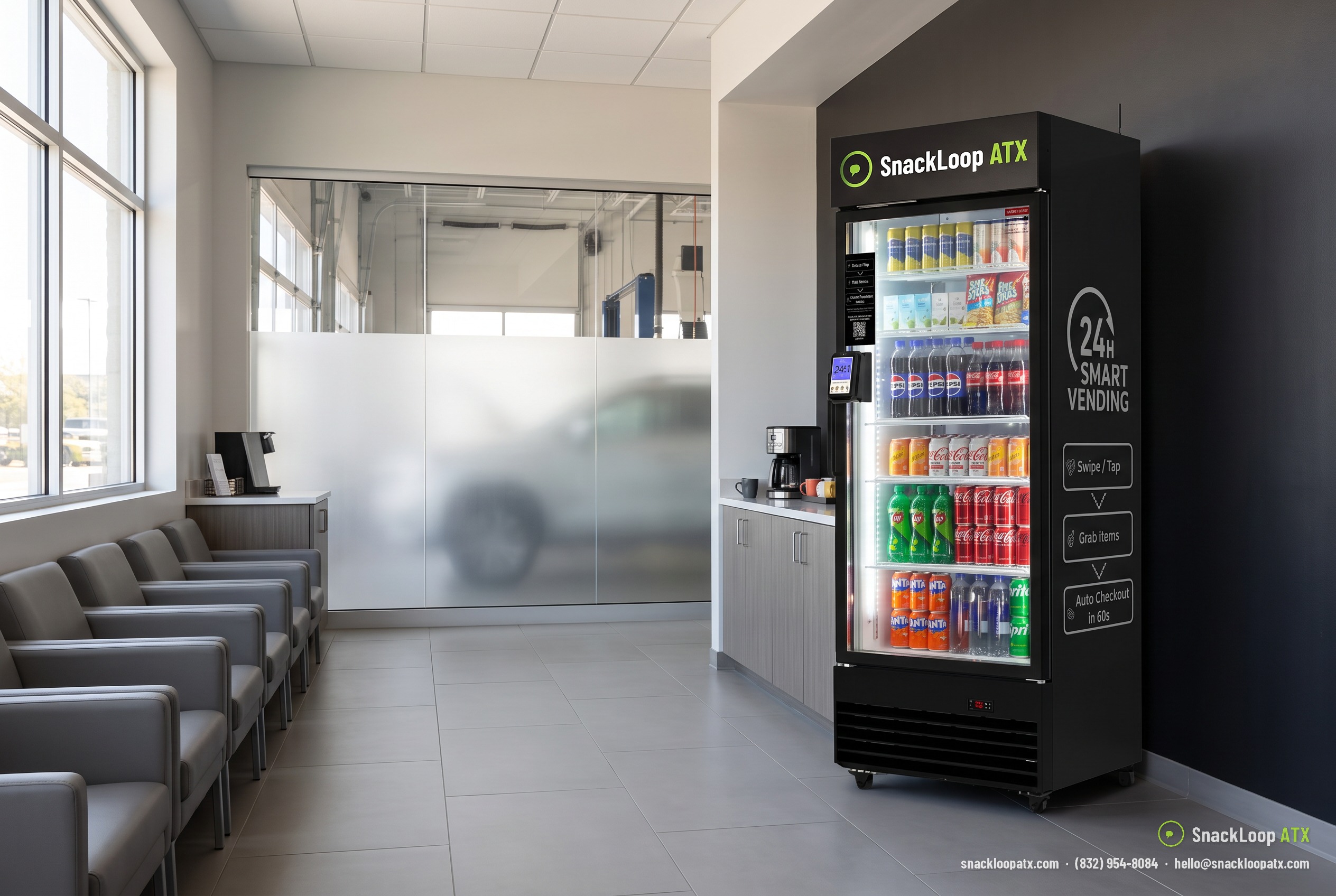
A vending placement is one of the few arrangements where the equipment, the stock, the money and the maintenance can all belong to somebody else. That is the appeal. It is also exactly why the conversation before signing deserves a handful of plain questions.
The questions below are not clever and they are not traps. Each has a short, specific answer that an operator running the placement properly gives without stalling. What you are testing is not whether the answer is the one you hoped for, but whether a settled answer exists at all.
We should say the obvious early: we are a vending operator in Austin, and you should put every one of these to us too. An article that is only useful when the answers favor us would be advertising. Some of these we answer well. On others the honest answer is that it depends on your building and has to be settled in writing before installation.
| The question | What a weak answer sounds like |
|---|---|
| Who owns the machine, and who pays for repairs? | "Don't worry about that part", or a pause, then "it depends" |
| How often is it restocked? | "Regularly." No schedule, no trigger, nothing you can check |
| What if the product mix is wrong for us? | "People buy whatever is in there" |
| How do people pay? | Cash described first, card mentioned as something coming later |
| How does the placement end? | The exit gets discussed only after you have signed |
| Who do I call when it fails? | A general voicemail box and an assurance that they are responsive |
Who owns the machine, and who pays when it breaks?
Start here: every other term inherits from this one.
There are broadly two structures. In the first, the operator owns the machine and carries the cost of every part, repair and service call. In the second, the host buys or leases the equipment and the operator services it: for a fee, out of a revenue share, or under a contract that keeps charging after the machine has stopped earning.
Neither is automatically a bad deal; owning your equipment can suit a business that wants full control of pricing and selection. What is not acceptable is being unsure which one you signed. Ask it in the least elegant way possible: if the cooling fails in August, who pays for that?
An operator who cannot say who pays for repairs is less likely to be hiding a bad answer than to be admitting there isn't a settled one. And an unsettled answer becomes a negotiation at the worst possible moment, while a warm machine sits in your breakroom in an Austin summer.
Ours: SnackLoop ATX owns the equipment. We deliver it, install it, and service and repair it at our own cost. You provide the floor space and a standard power outlet.
How often does someone restock it, and what decides that?
"Regularly" is a reassurance, not a schedule.
There are two honest answers. One is a fixed route: someone comes on set days whether the machine needs it or not. The other is demand-driven: the machine reports what has sold, and a visit is triggered by what is running out. Both are legitimate. A company that can describe neither is not.
The follow-up is more revealing. What happens between visits if the most popular item sells out on day two? If nobody knows until the next scheduled stop, you have learned something about how the machine will look by Friday afternoon. A half-empty machine reflects on your building, not on the operator's route sheet.
Ours is a regular schedule adjusted to what the site actually sells, and managing it is our job. Ask us to put that in writing too. You never order product, count inventory or deal with suppliers.
What happens if the product mix is wrong for your site?
The first fill is an estimate. A well-informed one, if whoever built it actually looked at the building, but still an estimate.
A site with a night shift, one full of drivers passing through, and a waiting room where people are stuck for the length of an appointment do not want the same shelf. Ask three things: how soon the mix gets adjusted, who decides, and what the change costs you.
If changing the selection triggers a fee or an amendment to the agreement, then in practice it will not change, and the machine slowly becomes furniture with a light in it.
Then ask what happens with requests. If there is no route back from "people here keep asking for X" to the person who loads the machine, there is no mechanism for it to improve. If something is selling out faster than expected or not moving at all, that is ours to notice and ours to correct.
Can people pay by card, and who covers the transaction cost?
Two separate questions, usually answered as one.
The first is what the machine accepts. Cash-only equipment means a bill validator that can reject worn notes, a coin mechanism that can jam, and someone at your front desk being asked for change. If card or contactless is described as arriving later, treat that as today's answer.
The second usually gets skipped. Whatever a card transaction costs to process, that cost lands somewhere: on the operator, inside a revenue share, or on the shelf price your staff pays. Any of the three can be reasonable. What is not reasonable is not being told which. Ask directly, and ask whether the price on the shelf is the price at checkout.
Ours: card or contactless tap, no cash, no coin mechanism, no keypad codes, and checkout completes automatically in about 60 seconds.
What does the agreement actually commit you to, and how does it end?
Read the exit before anything else. It is the section people skim when everything feels friendly, and the only one that matters when it stops feeling friendly.
Four things to locate in the document: how much notice you must give, whether it renews automatically and what window you have to prevent that, whether ending early carries a fee, and who removes the machine and how quickly.
That last item is the easiest to overlook and the hardest to fix afterwards, because a machine nobody services still occupies the same corner of your breakroom. "We would never make it difficult" describes a personality, not a term. Get the removal obligation and the timeframe written down.
If you are already in an agreement, the sequencing matters more than the notice letter itself. We set that out separately in how to move vending providers without ending up with an empty wall.
On our side: no long-term lock-in. The terms of the placement itself depend on the location and are agreed before installation.
Who do you call when something goes wrong, and how fast do they answer?
Everything above is about the arrangement working. This one is about the day it doesn't.
Ask three things: who specifically, through what channel, and what happens when that channel goes quiet. A general voicemail box with no named person behind it is not a support answer, and neither is a number that reaches whoever happens to be free. You want to know who owns the problem.
Then ask for a response window, in writing. Any operator can say they are responsive, and most mean it at the time. A stated timeframe in the agreement is a commitment; "we're very hands-on" is a mood. That applies to us as much as anyone. Ask before you sign, and if a response commitment has not been put in front of you, ask for one.
Six questions, none technical, all answerable in a sentence by anyone who has thought seriously about the placement. Take them to every operator you talk to, and take them to us: if you would like us to look at your space, the application form is short.
Frequently asked questions
What is the most important question to ask a vending company?
Who owns the machine and who pays when it breaks. Every other term follows from that answer. If the operator owns the equipment, repairs and parts are their cost and not a line on your invoice. If you own or lease it, service is something you are buying, and you need to know what that service includes before you sign.
Who pays if the vending machine breaks down?
That depends entirely on the structure you agreed to, which is why it has to be asked out loud rather than assumed. Some placements put every repair on the operator; others leave the host holding the equipment cost. With SnackLoop ATX the machine is ours, so service and repair are at our cost, not yours.
How do I find out how often the machine will be restocked?
Ask what triggers a visit, not how often one happens. A fixed route and a demand-driven schedule are both legitimate answers, and either one tells you something concrete. What tells you nothing is the word "regularly" with no schedule, no trigger and no way for you to check what the machine is running low on.
What should a vending agreement say about ending the placement?
Four things, in the document rather than the sales conversation: how much notice you have to give, whether it renews automatically and how you stop that, whether ending early costs anything, and who physically removes the machine and how soon. The removal clause is the one worth reading before signing rather than after.
Should I ask SnackLoop ATX these same questions?
Yes, all of them, and you should expect specific answers rather than reassurance. We own the equipment, we cover service and repair, payment is card or contactless tap with no cash handling, and there is no long-term lock-in. Anything that depends on your particular site should be settled in writing before installation.