One building, two populations: when does a second machine make sense?
A second machine makes sense when the building holds two groups that never share a path at the same hour. A dealership lounge and a service bay are one address and two populations. Walking distance and break timing tell you which you have, sooner than headcount does. If one machine is standing in the middle disappointing both sides, the count was never the question.
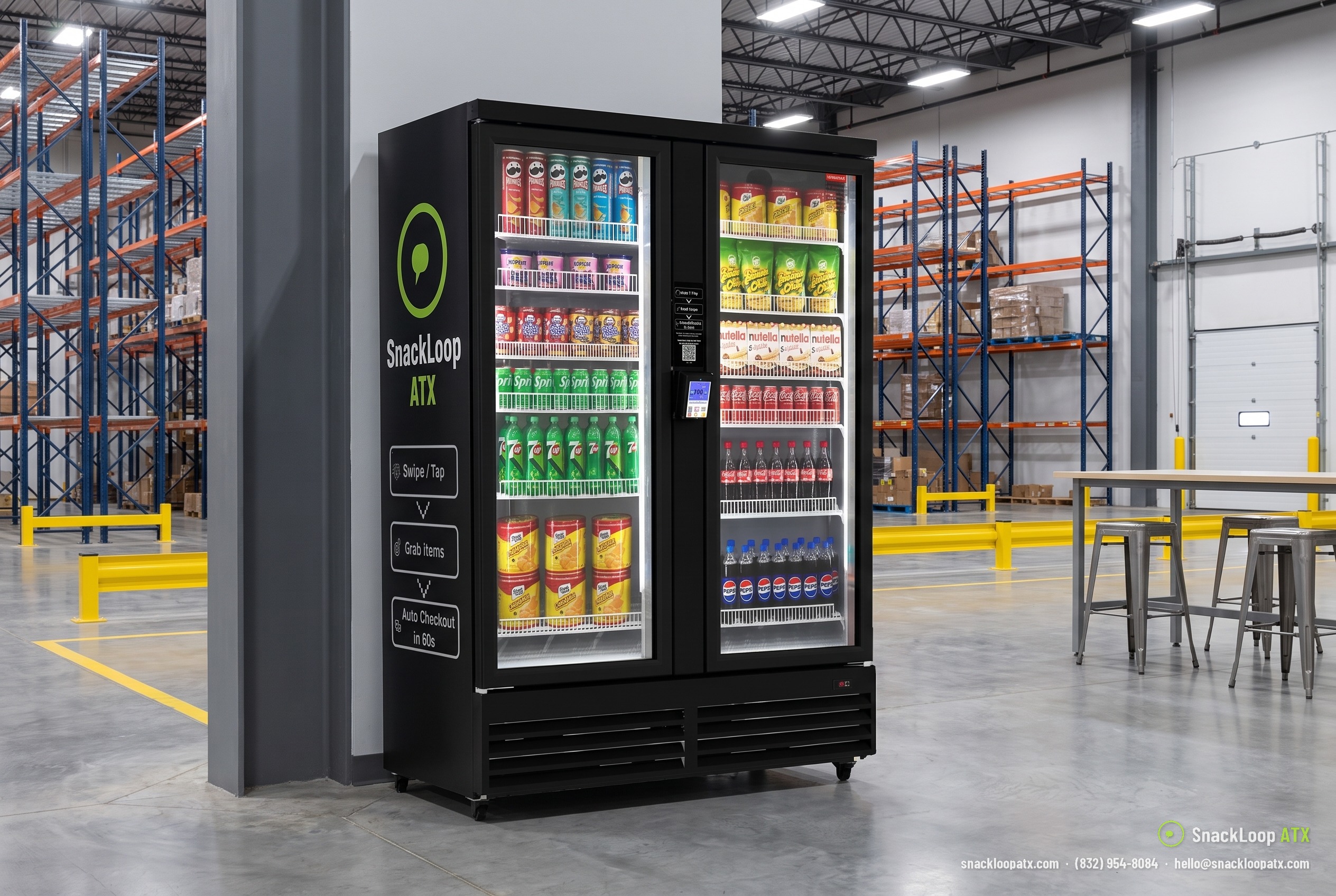
Some buildings are really two buildings. A dealership has a customer lounge at the front and a service bay at the back, and the people in them want different things at different hours. A warehouse has an office at the front and a floor behind it. A clinic has a waiting room and a staff area.
Do you have one population or two?
Walk the building at break time and look at the doors rather than the people.
One population shares a path. Everyone passes roughly the same spot on the way to the same break, so a machine standing there is available to all of them. Two populations are separated by a door, a yard, a counter nobody crosses, or an hour when the other group is still working.
Headcount cannot see any of that. It counts everyone in the building, while the machine only serves the people who can reach it in the time they have. Measure distance and timing instead.
Why does walking distance tell you more than headcount?
Because a break spent walking is not much of a break. Our reading, and it is a reading, is that people work that out and stop making the trip.
Do the walk yourself, from each group's normal position and at the hour they take it: from the bay, from the back of the floor, from the nurses' station. If one group arrives without thinking about it and the other has to weigh up the trip, you have two populations, whatever the payroll says.
Break timing says the same from the other direction. A front office that pauses around midday and a floor that rotates short breaks all morning are never at the machine together, so one machine is asked to be right at two different hours for two sets of appetites.
In Austin the walk may change with the season too. Our reading, not a measurement, is that a crossing which is nothing in March becomes a decision in August, when it means leaving air conditioning to cross a yard. Your own yard will settle that faster than we can.
What goes wrong when one machine tries to serve both?
Our reading is that it ends up half right for everybody, which is worse than being right for one group.
A machine has a finite number of rows. Every row given to something the lounge reaches for is one not given to something cold for the floor, so the shelf becomes a negotiation, and our reading is that neither side comes out of it well.
The second cost lands on the selection. We set the mix by elimination: put in a wide range, then pull what does not move, and let the shelf report back. When two groups with opposite needs buy from the same rows, that report arrives mixed together, and our reading is that it takes much longer to learn anything from it.
Why might the second machine be a different machine?
Because it answers a different question rather than adding capacity to the first.
A slim drinks cooler beside a work area is not a smaller version of a combo unit in a lounge. It is another job: cold, fast, on the way past, while the combo in the lounge is for somebody who is not going anywhere.
We already see that between buildings: the same product behaves in opposite ways from one site to the next. Hard boiled eggs packaged two to a pack moved in some buildings and did not move in others. A ham and cheese sandwich moved while a chicken salad sandwich went nowhere. Snack and lunch items get rotated week to week for that reason, packaged grilled chicken one week and sliced steak bites the next. Requests come in for regional products too, and in Texas that includes Big Red.
Our reading, and it is a reading rather than proven, is that two areas inside one building can differ as much as two separate buildings do.
Why is the staff and customer split so easy to miss?
Because of where the machine goes, which has nothing to do with either group.
A machine placed where visitors will see it, in the lobby, the lounge or the waiting room, is answering a question about how the building presents itself. That is a reasonable question to answer. The result is that the people who work there walk past it all day on their way somewhere else, so it stands on the visitor path instead of the working path.
Stand where the machine is at a shift change and see who stops. If it is visitors and not the people in work clothes, the machine is on the visitor path.
What should you look at before asking for a second one?
Five things, none of which requires asking us.
| What to watch | What it would tell you |
|---|---|
| The walk from each group's usual position, at the hour they break | Whether the far group can reach it at all, not whether they would like to |
| Whether the two groups break at the same hour or at different ones | Whether one machine is asked to be right twice in a day |
| Where staff stop, against where they only walk past | Whether the machine stands on the working path or the visitor path |
| Which rows empty first, and whether that changes by day | Which of the two groups the machine is serving now |
| Whether the second spot has a standard outlet and door clearance | Whether the location works before anyone discusses product |
If they point the same way, say so plainly. "Our floor cannot get to the lobby machine on a break" is easier to act on than "we want another one".
SnackLoop ATX delivers, installs, stocks and restocks the machine on a regular schedule, and services and repairs it at our own cost. The machine and its stock remain ours until somebody pays. You provide floor space and a standard power outlet. Payment is a card or contactless tap with automatic checkout in about 60 seconds, and there is no cash, no coin mechanism and no keypad codes. Placement terms vary by location and are agreed before installation, and there is no long-term lock-in. If you would like us to look at a second spot, the application form takes about a minute.
If the machine you already have is the problem rather than the number of machines, we set that out in switching vending providers without a gap in service.
Start with the walk. The rest follows from who can reach what, and when.
Frequently asked questions
How do I know whether my building has one population or two?
Walk it at break time, starting from each group's usual position rather than from reception. See who reaches the machine without thinking about it and who has to decide whether the trip is worth it. If one group has to decide, you have two populations.
Would a bigger machine work instead of a second one?
A bigger machine still stands in one place, so it answers volume rather than distance. If both groups already pass the same spot, more capacity there is the simpler fix. If they do not pass it, the extra rows do little for whoever is furthest away.
Does the second machine have to be the same as the first?
No, and there is no reason it has to be. A slim drinks cooler beside a work area is a different job from a snack and drink combo in a waiting room. We set the mix by elimination, so two units under one roof can end up stocked quite differently.
Our machine is in the lobby and staff walk past it all day. Is that two populations?
Possibly, and it is an easy split to miss. A lobby machine is placed where visitors will see it, which is a decision about how the building presents itself rather than about who buys. Watch at a shift change whether staff stop or keep walking.
What does a machine cost the host?
Nothing, for any machine we place. We deliver it, install it, stock it, restock it on a regular schedule, and service and repair it at our own cost. The machine and its stock stay ours until somebody pays. You provide floor space and a standard outlet.