A 55+ community is not a workplace, and the machine has to know that
In a 55+ community the machine is not competing with hunger. Everyone has a kitchen a short walk away, so it competes with the habit of going home. That means it earns its place at the clubhouse around what already happens there: cards, classes, the afternoon everyone lingers. It belongs in the amenity column, not the income column.
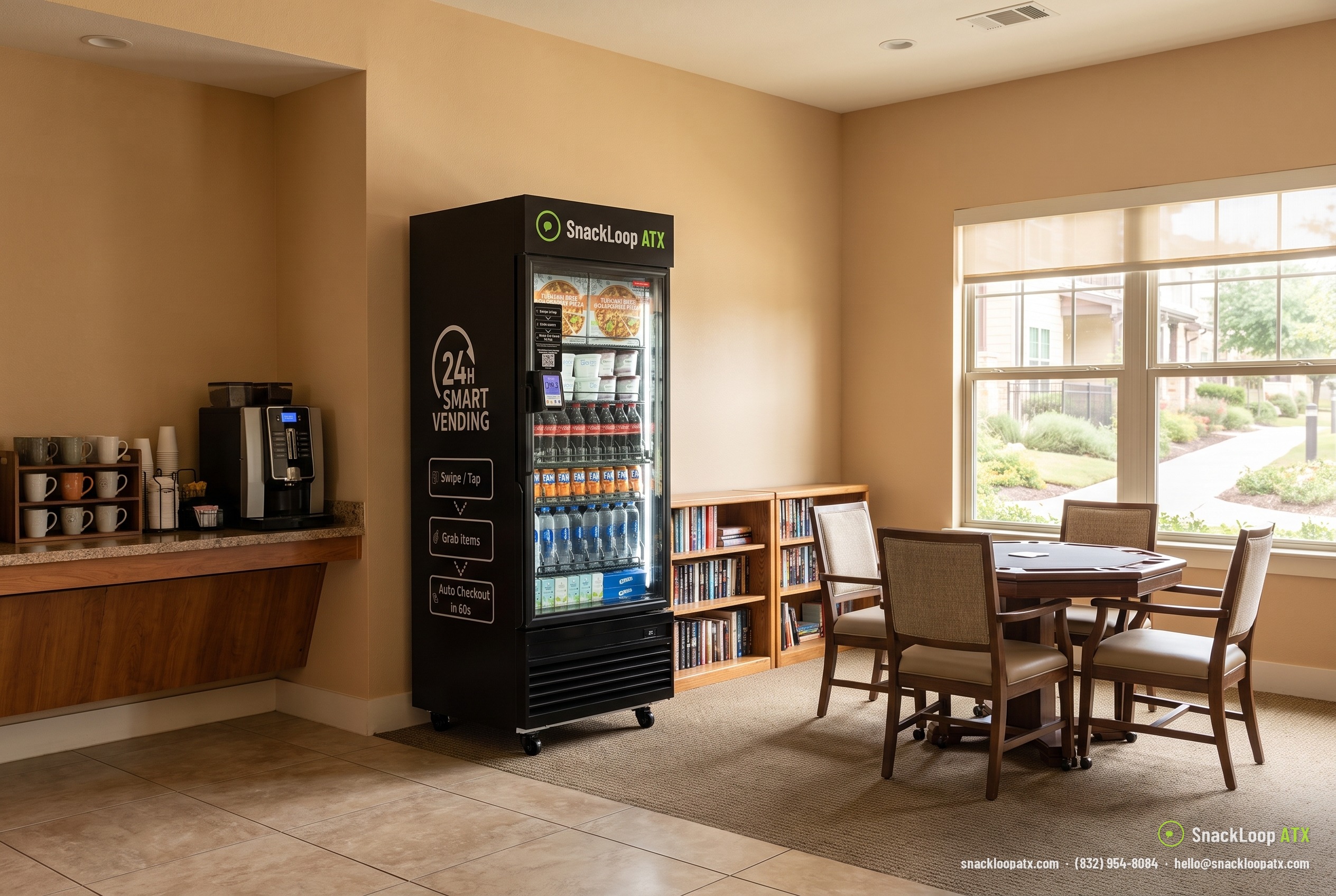
The mistake I would make with a 55+ community, if I judged it the way I judge an office, is to count residents and stop there.
What is the machine actually competing with?
A kitchen upstairs, and the habit of using it.
In an office or a warehouse the machine competes with an inconvenient errand: leaving the building, driving somewhere, coming back. It wins because the errand is worse. In a residential community it competes with going home, and going home is easy. Everyone has a full kitchen a short walk away and no reason to hurry.
That does not mean the machine has no place. It means the reason it gets used is different. People buy from it when going home would interrupt something: a card game in progress, a class about to start, a conversation nobody wants to end. The machine is not solving hunger. It is saving the moment.
When does a clubhouse machine make sense?
When the clubhouse is genuinely busy.
The signal is not how many residents live there. It is how many days a week the common room has something happening in it. A community running cards, fitness classes, committee meetings and a Friday social has people sitting in one room, repeatedly, with time on their hands. A community where the clubhouse is opened for the occasional meeting does not.
Around Austin these communities sit mostly out at the edges (Georgetown, Round Rock, Kyle, Buda), and they differ enormously in how much the clubhouse is actually used, whatever the brochure says. That is a question a community manager can answer by looking at the activity calendar, and it tells you more than the resident count does.
What changes about the shelves?
Nobody is rushing, and that changes what makes sense.
In a warehouse the winner is whatever can be opened one-handed on the way back to the floor. Here nobody is going back to anything. There is time to sit down with what you bought, and often somebody to share it with.
The other honest difference is payment. Our machines are card and contactless only: no coin mechanism, no keypad, no cash. For most people that is a convenience. In a community where a meaningful number of residents would rather pay cash, it is a real limitation, and it is better raised at the survey than discovered afterwards by a resident standing in front of a machine holding cash.
Is this an amenity or an income stream?
In most 55+ communities, an amenity. That changes what the arrangement should look like.
A property manager evaluating this as revenue will usually be disappointed by a clubhouse. A property manager evaluating it as something residents ask for, alongside the coffee station and the puzzle table, is asking the right question.
That is why the terms here are not one-size-fits-all. The terms depend on the location. Others are simply an amenity: the machine costs the community nothing, and it is there because residents would rather have a cold drink available in the common room than walk home for one. Which arrangement applies depends on the location, and it is settled before anything is installed.
| What the community is optimizing for | What that usually points to |
|---|---|
| A resident amenity, clubhouse used most days | The machine as an amenity |
| A busy clubhouse with strong visitor traffic | Worth a conversation about terms |
| A quiet clubhouse opened occasionally | Probably not yet, and worth saying so |
What does the community have to do?
Provide the floor space and a standard power outlet, and nothing else.
We deliver, install, stock, restock on a regular schedule, and service and repair the machine at our cost. Nobody on the community's side orders product, counts inventory, handles money or calls a technician. Payment is a card or contactless tap with automatic checkout in about 60 seconds.
If you would like us to look at your clubhouse, the application form takes about a minute. And if there is already a machine in the common room that residents have quietly stopped using, that is worth fixing rather than living with. We cover it in switching vending providers without a gap in service.
So what should you check first?
Open the clubhouse activity calendar and count the days something is scheduled. Then ask two or three residents how they would feel about a card-only machine. Those two answers tell you more than the resident roster, and they take an afternoon rather than a study.
Frequently asked questions
Does a 55+ community have enough traffic for a vending machine?
It depends less on the number of residents than on how busy the clubhouse is. A community where the common room is used most days for cards, classes and meetings gives the machine a reason to exist. One where residents mostly stay in their own homes is a harder case, and worth saying so before anything is installed.
Do we have to pay for it, or does it pay us?
Neither, necessarily. The terms depend on the location, and in many buildings the machine is simply an amenity. Which applies depends on the location, and it is agreed before installation, not after.
What if residents prefer to pay cash?
Then it is worth knowing before the machine arrives. Ours are card and contactless only, with no coin mechanism, so a community where many residents would rather use cash is a poor fit and we would rather say that at the survey than install something half the building cannot use.
Where should it go in the clubhouse?
Near the coffee station or wherever people already gather between activities, not in an entry corridor. The point is that it sits where somebody is already standing still, and that it does not look like equipment dropped into a room that was designed to feel like a living space.
Who handles restocking and repairs?
We do. We deliver, install, stock, restock on a regular schedule, and service and repair the machine at our cost. Nobody on the community's side orders product, counts inventory or calls a technician. The community provides floor space and a standard power outlet.