A vending machine in an apartment building competes with the elevator
A machine works in an apartment building only where residents are already standing still, which in most buildings means the package room or a genuinely used amenity lounge rather than the lobby. Everyone here has a kitchen upstairs, so it competes with going home rather than with hunger. That makes apartments a harder case than a workplace, and it makes the exact room inside the building the whole decision.
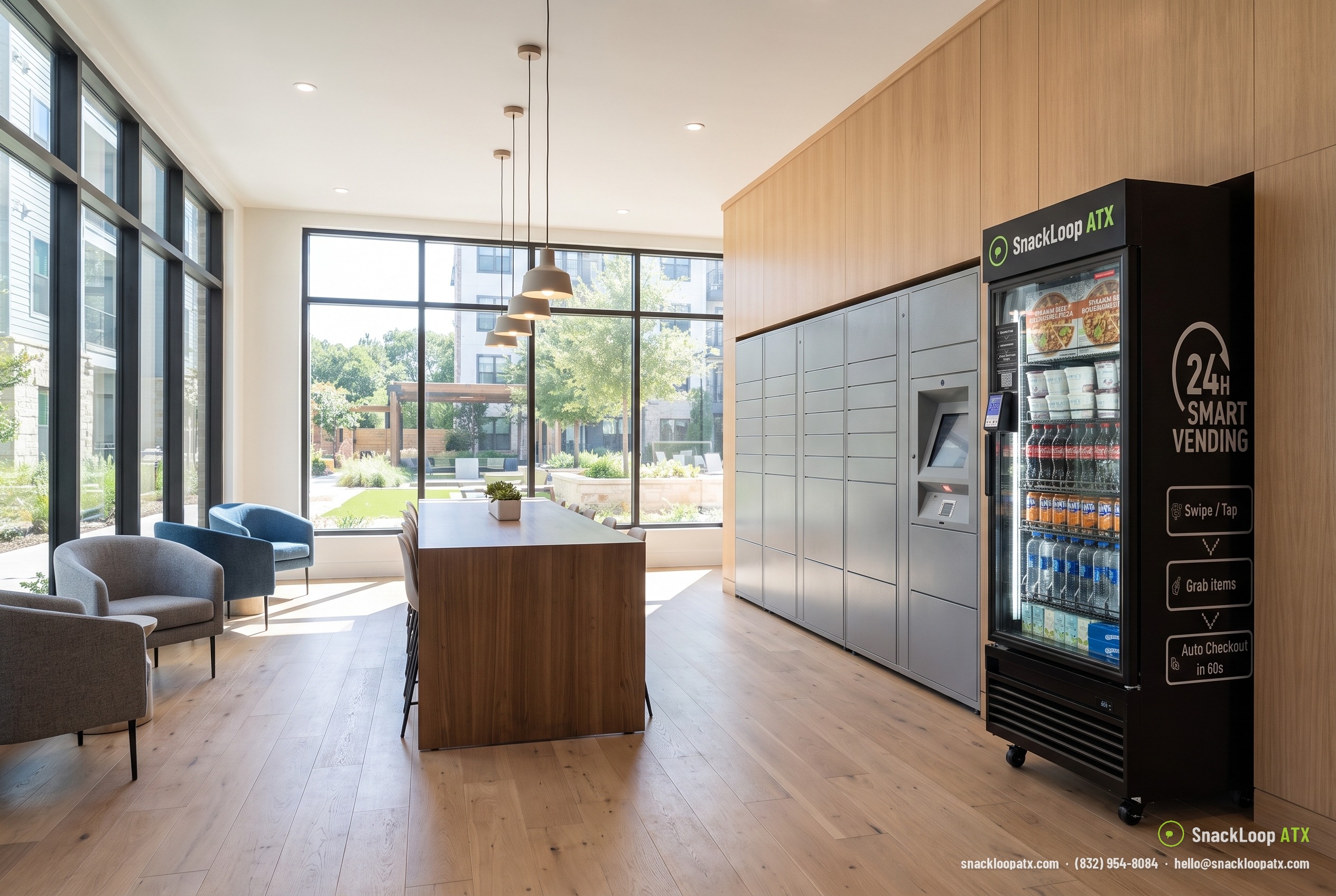
An apartment building looks like an easy placement from the outside: hundreds of people, one front door, movement all day. It is one of the harder venues in vending, and the reason has nothing to do with how many people live there.
What is the machine competing with in an apartment building?
A kitchen upstairs, and how little effort it takes to reach it.
In an office the machine wins because the alternative is an errand: leave the building, drive somewhere, get back before the break ends. Here the alternative is an elevator ride. Nobody is hungry and stuck. They are hungry and a short walk from their own refrigerator.
So the machine is not selling food. It is selling not going upstairs, which is a much smaller thing to sell. It gets bought when going up would cost the resident something: a parcel in both hands, a load still in the dryer, a kid already halfway to the pool.
Why is an apartment lobby the weakest case in vending?
Because footfall and dwell time are not the same thing, and a lobby gives you the first without the second.
Someone crossing a lobby is going somewhere. Passing a machine is not standing in front of it, and every strong vending venue has the same thing in common: somebody is already waiting there, with time they did not choose to have.
Plainly, then: a machine in a pass-through lobby, with no seating and no reason to pause, is about the weakest configuration in this business. If that is the only spot a building can offer, the honest answer is to look at another room or wait.
Does the package room change that?
It is usually the one room where the answer flips.
Residents come down to the package room on purpose, and they are looking for a name on a shelf when they get there. If the room opens with a code or a scan, the phone is already in their hand, which is also how they would pay. And going back up empty-handed feels different from going back up with a cold drink.
Here is how the rooms of a typical building compare, before any of them is surveyed:
| Where the machine stands | Whose path it sits on | What that situation calls for |
|---|---|---|
| Package room | Residents who came down on purpose and pause to find a parcel | Survey this room first; put it where the pause happens, not behind the door |
| Amenity lounge or resident co-working room | People already sitting down, working or waiting on someone | Worth doing where the room is used most days, not where it is booked occasionally |
| Laundry room | Residents tied to the building for the length of a cycle | Dwell time with no alternative; a slim cooler often suits the space better than a combo |
| Pool or fitness room entrance | Residents who left without a wallet and come back thirsty | Cold drinks, and contactless matters more here than anywhere else |
| Bare lobby, no seating | Everyone, briefly, on the way to somewhere else | The weakest configuration; better to say so than to install one and hope |
The ranking is reasoning, not a report: the more a room holds someone still with no alternative in reach, the more a machine has to offer them.
What do guests, turnover and short stays add?
They are the part of the building with no kitchen upstairs.
A resident always has an easy alternative. A visitor waiting in the lobby does not, and neither does a contractor working in a unit or somebody in a furnished short-term unit who has not been to a store yet. Those people are the office-worker case inside a residential building: briefly stuck, nothing nearby, no fridge of their own.
Turnover works the same way on a slower cycle. Where leases turn over steadily, some share of residents is always new, still learning which door is the mail room, not yet stocked up on anything. A machine near move-in and package traffic is on the path they are already walking; one down a side corridor has to be told about, and nobody tells anybody about a vending machine.
In Austin the same question fits very different buildings: a downtown high-rise with a staffed lobby, a garden-style community out past the Domain. Which room here do people actually stand still in?
What does the property actually have to provide?
Floor space and a standard power outlet. That is the whole list.
We deliver the machine, install it, stock it, restock it on a regular schedule, and service and repair it at our own cost. Nobody on the property side orders product, counts inventory, handles money or calls a technician. Residents and guests pay by card or contactless tap with automatic checkout in about 60 seconds. There is no cash, no coin mechanism and no keypad codes, and so no cash box in a room every resident can badge into.
Terms vary by location. Whichever applies is settled before installation.
If you would like us to look at your package room or amenity floor, the application form takes about a minute. And if there is already a machine residents quietly stopped using, that is a different problem, and we cover it in switching vending providers without a gap in service.
So what should you check first?
Walk the building in the evening and find the place where somebody is standing still. If it is the package room, you have your answer and it is a good one. If it is the laundry room or a lounge that fills most afternoons, you have a real candidate. If the only honest answer is "the lobby, on the way past", the machine offers nothing the elevator does not offer faster, and it is better to hear that before it is bolted to your wall.
Frequently asked questions
Does a vending machine make sense in an apartment building at all?
It depends on whether the building has a room where residents stop moving. A busy package room, a laundry room or an amenity lounge used most days gives a machine a reason to exist. A building whose only shared space is a lobby people cross on the way up is a weaker case, worth saying so before installing.
Where should it go, the lobby or the package room?
The package room, in most buildings, or whichever room residents already stand still in. A lobby gives you everyone in the building briefly and nobody for long. Put the machine where the pause already happens, in sight of the door rather than around a corner, and where somebody with a parcel in one hand can still reach it.
Do we pay for the machine, or does it pay the property?
Either can apply, and sometimes neither. The terms depend on the location and are agreed before installation, and in many buildings the machine is simply an amenity. Which one fits depends on the location, and it is agreed before installation rather than after.
Who restocks and repairs it, and what does our team have to do?
We deliver, install, stock, restock on a regular schedule, and service and repair the machine at our own cost. Nobody on the property side orders product, counts inventory, handles money or calls a technician. The property provides floor space and a standard power outlet, and that is the entire list of obligations.
How do residents and guests pay for anything?
With a card or a contactless tap at the machine, and checkout completes automatically in about 60 seconds. There is no cash, no coin mechanism and no keypad codes, which also means there is no cash box sitting in a room residents can access. A guest with no fob and no kitchen upstairs can buy exactly like a resident.