An auto shop has two customers for one machine, and they buy opposite things
An auto shop has two buyers for one machine and they want opposite things. The customer in the lounge is stuck waiting with nothing to do, so what helps is something that fills the wait. The technician has a short gap between jobs and wants something cold in hand before the next car goes up. Place the cooler where both paths cross, or you are running it at half capacity.
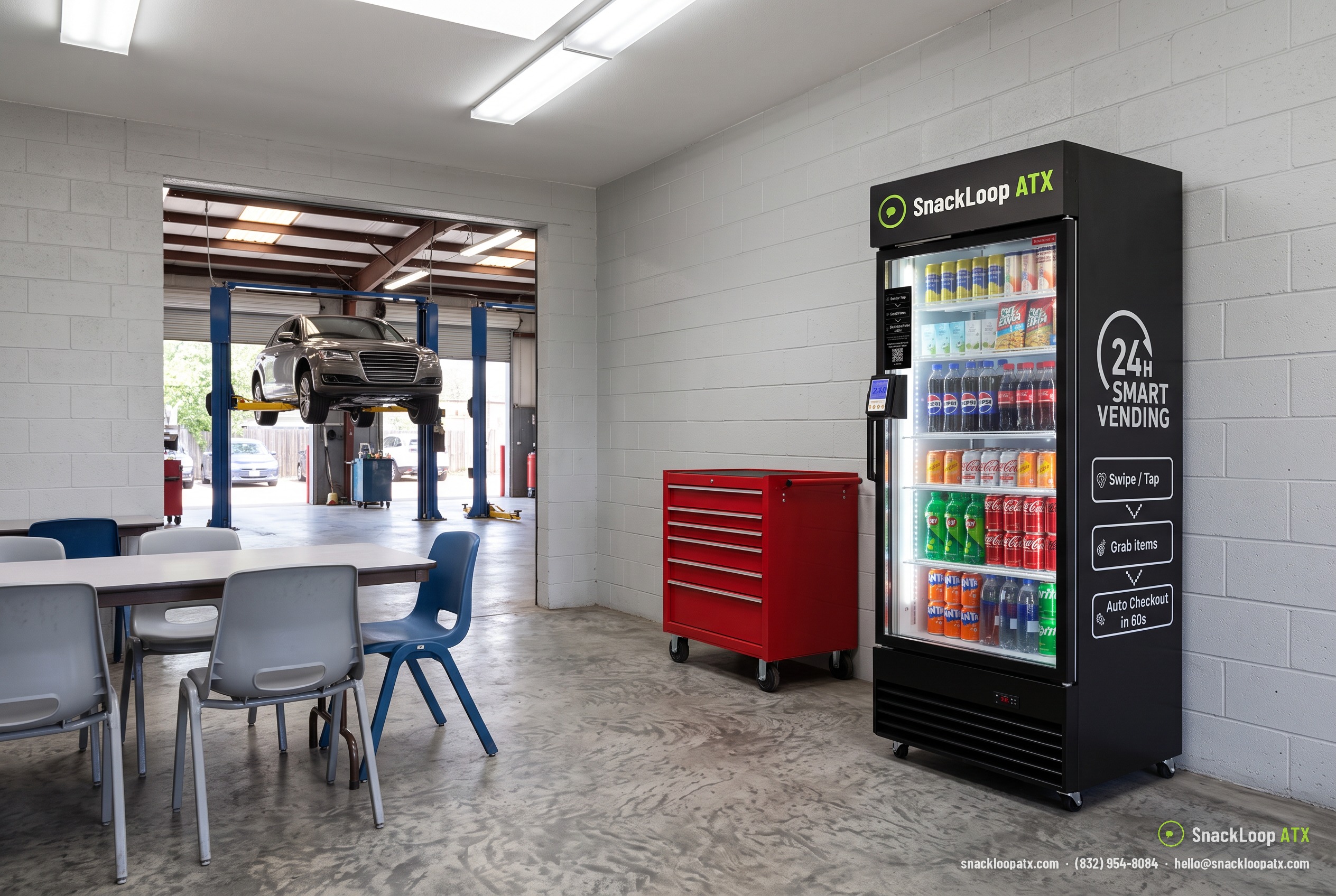
Most buildings I look at have one kind of buyer in them. An auto shop is the exception, and that is worth thinking about before judging the site on headcount alone.
Who are the two buyers?
The customer and the technician, and almost nothing about them is the same.
The customer did not plan to be here. They dropped the car off, were told it would be about an hour, and are now sitting in a room with a television they did not choose. They are not hungry so much as stuck. What they buy is a way to make the wait feel shorter.
The technician planned their whole day around this building. They have a short gap between jobs, they are warm, and they want something cold in their hand before the next car goes up. What they buy is relief, quickly.
One is killing time. The other is saving it. The same cooler has to answer both.
Why does waiting time matter more than headcount?
Because a captive hour beats a crowd with options.
A large office next to a coffee shop and a small service lounge can look very different on paper and behave the other way round, and the reason is not the number of people. It is that the customers in the lounge cannot leave. Their car is on a lift. They are not walking anywhere until it comes down.
The same logic applies to clinic waiting rooms and laundromats. Long wait, no alternative, no decision to make. That combination is what I look for first.
What does each side actually buy?
| Buyer | Situation | What that situation calls for |
|---|---|---|
| Waiting customer | Stuck for the length of the job, nothing else to do | Familiar drinks and snacks, something that fills the time |
| Technician | Short gap between jobs, physical work, warm shop | Cold drinks above all: water, electrolytes, soda |
| Service advisor | On their feet all day, no fixed break | Whatever is fastest to grab on the way past |
The lounge side rewards variety and familiarity. People reach for something recognizable while they wait. The shop side rewards cold and fast. A machine that only answers one of those is being used at half its capacity, in a building that was ready to give you all of it.
Where should it stand so both sides reach it?
Where the two paths already cross.
In most Austin shops that is near the service counter, or in the doorway zone between the lounge and the bays, somewhere a customer can reach without feeling like they are wandering into the workshop, and a technician can reach without a detour. Put it deep inside the lounge and the techs stop coming. Put it out on the floor and customers never see it.
If the two areas are genuinely separated, with no shared path at all, then the question becomes which side has the longer wait and the fewer options. Usually that is the lounge during the day and the shop floor at the end of it.
The practical requirements are the same as anywhere: a standard power outlet, clearance for the door to open fully, and a spot that is not in the path of anything moving. One Austin-specific note: a lounge with a west-facing glass wall gets hot in the afternoon, and a cooler works harder there. Place it away from direct sun if the room allows.
What does it cost the shop?
Nothing, in every direction.
SnackLoop ATX delivers and installs the machine, stocks it, restocks it on a regular schedule, and services and repairs it at our cost. You provide the floor space and a standard power outlet. Payment is a card or contactless tap with automatic checkout in about 60 seconds, so there is no cash in the building and nobody on your side counts inventory.
Placement terms depend on the location, and there is no long-term lock-in. If you want us to take a look, the application form takes about a minute.
If there is already a machine in the lounge and it is more often half-empty than full, that is worth fixing rather than tolerating. We cover it in switching vending providers without a gap in service.
So what should you check first?
Time your own waits. Not the estimate you give at the counter. The real interval between a customer handing over the keys and getting them back. Then stand where your service counter is and see whether a technician on a break would pass that spot without going out of their way. If both answers are yes, the building is already doing the hard part.
Frequently asked questions
Should the machine go in the customer lounge or in the shop?
Wherever both groups already pass. A spot near the service counter or the doorway between the lounge and the bays usually reaches customers and technicians without favoring either. If the two areas are genuinely separate with no shared path, it is worth looking at which group has the longer wait and the fewer alternatives.
Is a service lounge really enough traffic on its own?
It can be, because dwell time does what headcount cannot. A customer sitting through a repair with nothing else available is in a completely different position from someone crossing a lobby. That is why a shop with a modest number of daily service customers is worth surveying rather than dismissing on headcount.
What do technicians actually buy?
Cold drinks, mostly, and more of them in an Austin summer. Work in a shop is physical and the breaks are short, so the purchase has to be fast and refreshing rather than something to sit down with. Water, sports and electrolyte drinks and cold soda carry that side of the machine.
Will it look out of place in a customer-facing lounge?
Ours are black glass-front coolers with a lit interior, closer to a cafe fridge than to an old snack machine with buttons. There is no coin mechanism and no keypad. Customers tap a card or phone and the checkout completes on its own in about 60 seconds.
What does it cost the shop?
Nothing. We deliver, install, stock, restock on a regular schedule, and service and repair the machine at our cost. You provide floor space and a standard power outlet, and the placement terms depend on the location. There is no long-term lock-in, and nobody on your side counts inventory.