The school year restarts. Does your building's day move?
September can move the building's day, and a mix that fit in July can stop fitting. If part of your building runs on a school schedule, mornings can pull earlier, the lunch hour can tighten around a pickup, and the afternoon lull can land at a different hour than in August. That is not a school problem but a building one, and a school year starting is when to look at the shelf and say what is not working.
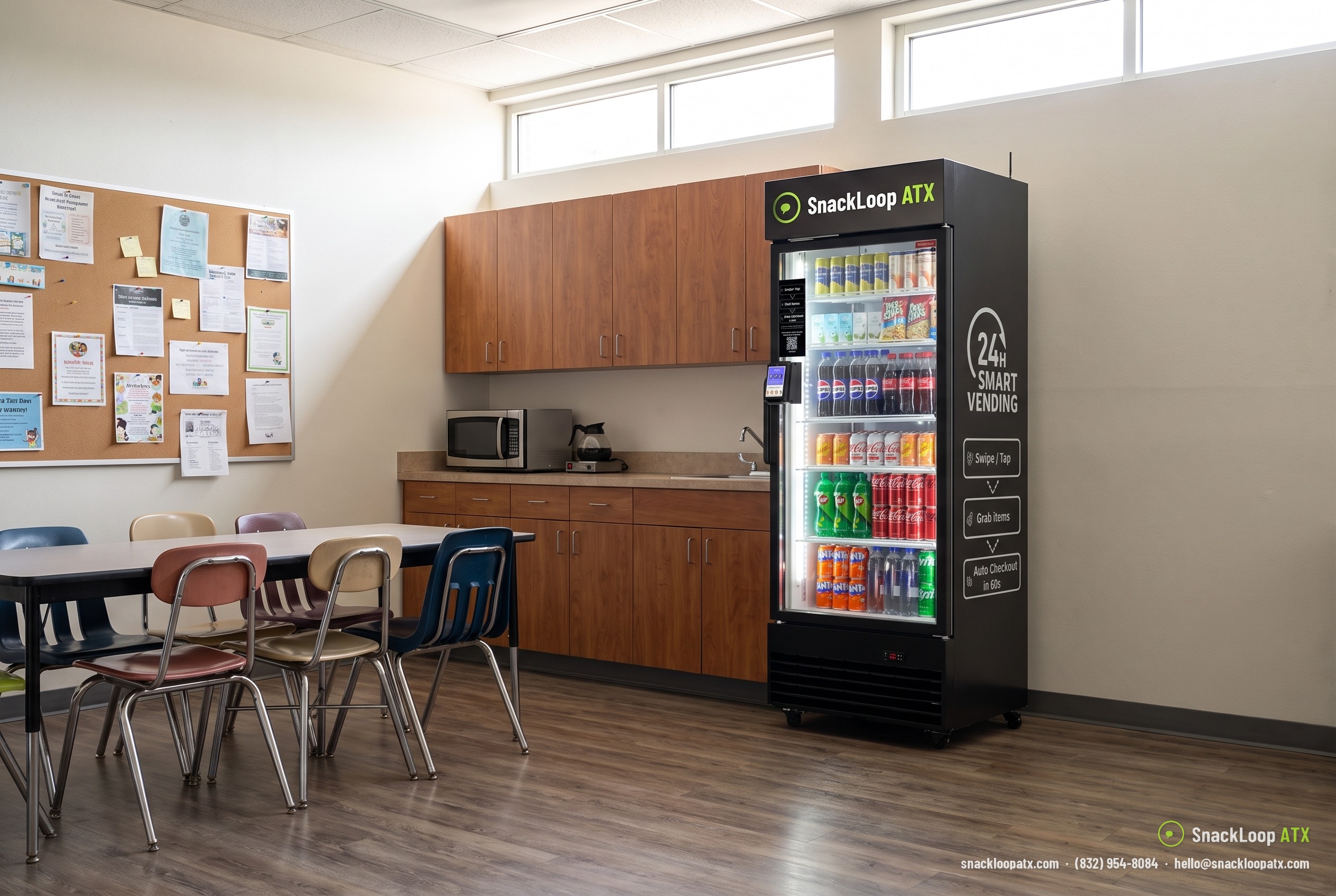
A machine does not know what month it is. It only sees who walks past it and when, and that is what the start of a school year can move.
I pay attention to the first weeks after classes begin, and not because any of this is about schools. The kind of buildings I have in mind are offices, shops, clinics and warehouses with no connection to a campus. What they have in common is people, and some of those people may have a drop-off and a pickup in their day.
What can change in a building that has nothing to do with school?
The hours can change, and nobody sends a memo about it.
If August in your building means vacations and half-empty floors, you already know what its lunch hour looks like. You are the only one who can say whether it changes. Mornings can pull earlier for anyone who has to be somewhere before work. The middle of the day can tighten around an errand that only fits at lunch. And the afternoon, the part I find most interesting, can slide.
The building has not changed. The day inside it may have.
What should you watch in the first weeks of September?
Watch the room, not the machine. The room is where a change in the hours is visible first, and looking costs you nothing.
| What to watch | Why it is worth watching |
|---|---|
| When people actually arrive | If the morning pulls earlier, the first purchase of the day moves with it |
| How long the middle of the day really is | A break that has to fit around a pickup is short. Whether short changes what people pick is something your own shelf will tell you |
| Which hour the afternoon lull lands on | The shelf is worth being full before that hour. Whether that hour has moved is something only your building can tell you |
| Who is back in the building | As vacation cover ends, floors can refill without anyone announcing it |
| What nobody has touched | An item nobody picks once the hours have moved says something about the new pattern, not about the item |
Nothing there needs counting or recording. Notice it once. A pattern is easier to see while it is still new to you.
Why would the mix move when the rhythm moves?
Because the mix was never a fixed idea. Here is how one gets set.
We put in a wide range and take out what does not move. That is the whole method. Elimination is slower than a formula, and we prefer it because it lets the building answer instead of a spreadsheet. It has to work that way: the same product behaves oppositely in different buildings, emptying in one room and sitting untouched in another. I would rather put it in, watch, and be corrected.
Which is why a change in rhythm matters. Our reading is that a break spent sitting down and a break taken on the way somewhere do not call for the same food. That stays a guess until the building corrects it, which is exactly how the mix gets set.
Why might a mix set in July stop fitting in September?
Because it was set for a different building. Same address, different building.
A shelf answers a question the building asked the day it was stocked: who was here, how long they had, what else was within walking distance. Change one of those and the answer goes stale even though nothing on the shelf did.
Austin does not make it simpler. An afternoon in September can still feel like August, so what people reach for on the cold side may not move on the same calendar as their hours. That is our reading, not a measurement. A mix left alone drifts out of fit instead of failing outright. Nothing breaks. It quietly stops being the right shelf.
How does rotation keep a shelf from going stale?
By not letting the same row sit there long enough to become furniture.
Snack and lunch items get rotated week to week on purpose: packaged grilled chicken one week, sliced steak bites the next. Part of that is variety. The rest is that a row which never changes stops telling us anything.
The start of a school year is a good moment to point that at your building, while a new pattern would still be visible. What you are looking for is not a favorite. It is the item nobody has picked since the hours moved.
What does this take from you, and what is worth doing now?
Almost nothing, and one conversation.
SnackLoop ATX delivers and installs the machine, stocks it, restocks it on a regular schedule, and services and repairs it at our own cost. You provide floor space and a standard power outlet. Nobody on your side orders product, counts inventory or calls a technician. Payment is a card or contactless tap with automatic checkout in about 60 seconds, and with no cash, no coin mechanism and no keypad codes, there is no cash box in your break room.
Placement terms depend on the location. Whichever applies is agreed before installation, and there is no long-term lock-in.
So do the cheap thing while the year is still new. Walk your own break room in the first weeks of the school year, at the hour you believe people go looking for something, and find out whether that is still the hour. Then say out loud what is not working on the shelf: it is ours to fix and yours to notice. If you would like us to look at the space, the application form takes about a minute. And if the same row has not changed in months, ask whoever services it to swap it. If that goes nowhere, we wrote separately about switching vending providers without a gap in service.
Frequently asked questions
Does the selection actually change during the year, or is it set once?
It changes. The first stock in any machine is an informed guess, and it gets corrected by what people pick and what they leave alone. Snack and lunch items also rotate week to week on purpose, so a row does not sit there long enough to become furniture that nobody looks at anymore.
What should I look at in my own building in September?
When people arrive, how long the middle of the day really is, and which hour the afternoon lull lands on now. Then look at what on the shelf nobody has touched since those hours moved. You do not have to count anything. You only have to notice it once.
Who decides what comes out of the machine?
We do, and it costs you nothing to say so. Tell us an item is sitting and it comes out. That is not a favor, it is how the mix gets set. You never buy product, count inventory, handle stock or dispose of anything, because everything inside the machine stays ours until somebody pays for it at the machine.
My building has nothing to do with schools. Why would September matter?
Because the machine does not see your building, it sees the people in it, and some of them can be on a school schedule even when the building is an office, a shop or a warehouse. If their mornings and breaks move, the hours the machine is used move too, and the shelf was set for the old hours.
What do I have to do, and what does it cost me?
You provide floor space and a standard power outlet. We deliver, install, stock, restock on a regular schedule, and service and repair the machine at our own cost. Payment is a card or contactless tap with automatic checkout in about 60 seconds, with no cash, no coin mechanism and no keypad codes.