Vandalism, theft and night access: whose problem is the machine?
The machine and everything inside it stay ours until a customer pays, so vandalism, damage and loss are our problem rather than a bill that lands on the host. There is no cash in it either, because payment is card or contactless only. What a host does control is narrower and more useful: where the machine stands, whether it sits in view, the lighting, and who can get into the space after hours.
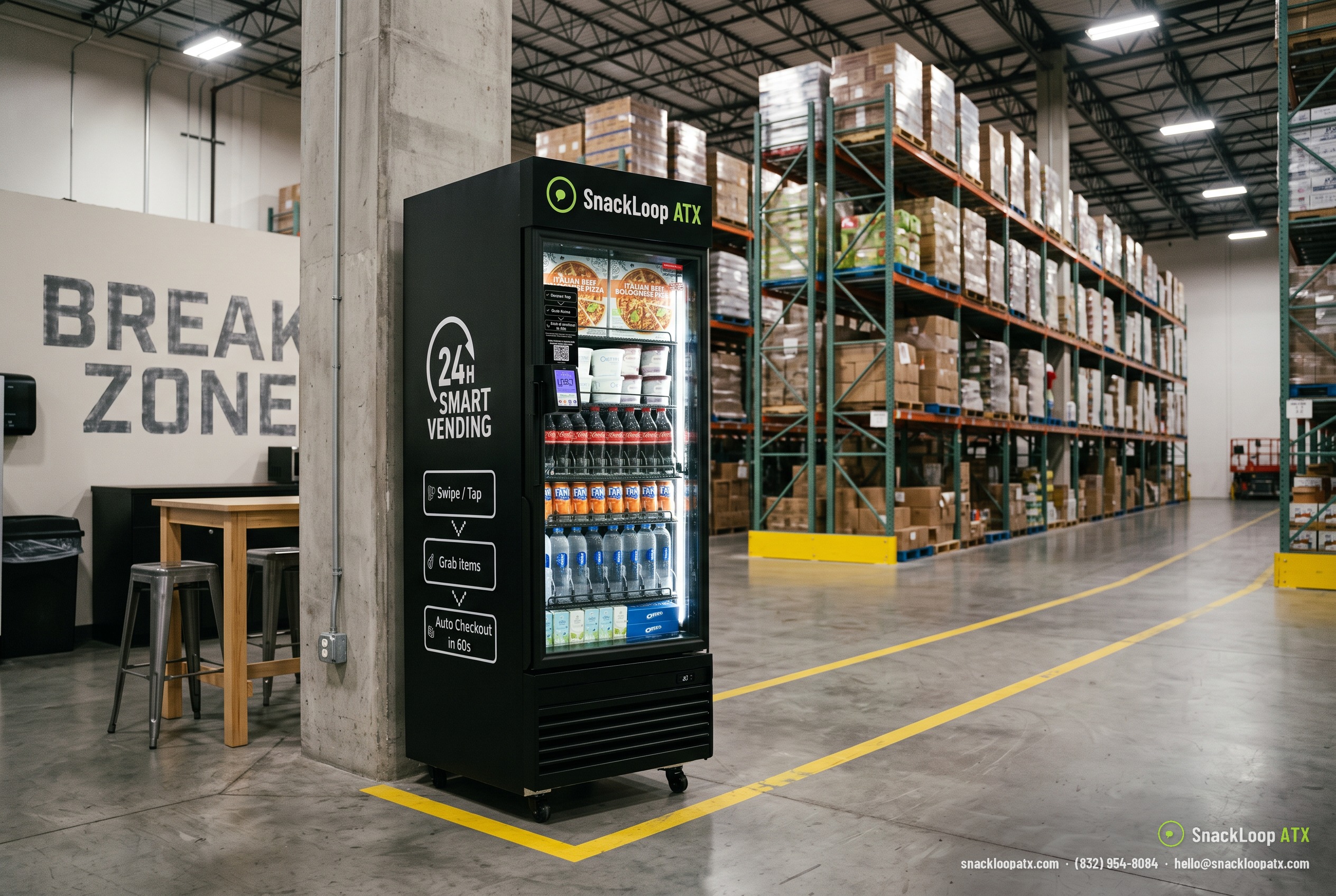
When I walk a space, I look at doors before I look at floor plans. Not because I arrive expecting trouble, but because doors settle two practical questions: who is near the machine when the building is quiet, and how we get in to restock without becoming a nuisance.
Who carries the risk if the machine is damaged?
We do. The machine is our equipment and the stock is our stock, so damage and loss sit on our side of the arrangement rather than yours.
Both the machine and the stock stay ours until a customer taps a card, and that is not a nicety, it is simply how the arrangement is built. Nothing in the corner of your break room belongs to you, so what stands there is our exposure, not a line item on your side.
That covers the ordinary wear as well as the dramatic version: a jammed door, a cracked front panel, a cooling fault. We deliver, install, stock, restock on a regular schedule, and service and repair the machine at our own cost. The host provides floor space and a standard power outlet. That is the entire list of what comes from your side.
What is actually inside the machine?
There is no cash in the machine at any point.
Payment is a card or a contactless tap, checkout completes automatically in about 60 seconds, and there is no coin mechanism and no keypad code. Nobody loads a float in the morning, nobody counts takings in the evening, and there is no cash box to empty because there is no cash at any stage.
The stock has real value and I am not going to pretend otherwise, but the value is what a shelf of groceries is worth, and it belongs to us rather than to you.
What does a host genuinely control?
Three things, and all three are decided before we plug anything in.
Where it stands. A machine in the natural path of the day, beside the break table or the time clock, is in front of people constantly. A machine parked in a corridor nobody walks is unattended for long stretches simply because nobody has a reason to pass it. Sightlines are the cheapest thing on this list and the easiest to give away, because the tidiest corner in a building is usually also the least visible one.
Light. A machine in a lit area is a machine people can see. A dark alcove at the end of a hallway gives you none of that, and the fix is usually nothing more than choosing a different wall.
Who is in the space after hours. Your own crew, a cleaning contractor, tenants who share a lobby, nobody at all. None of those answers is a problem in itself. Knowing which one applies is what lets us pick the wall sensibly instead of guessing.
Does a night shift make a site harder to serve?
I would put it the other way round.
A crew working overnight often has fewer places to go than the day crew, and what is open near your building at that hour is worth checking for your own address rather than assuming. That is the shift where a cooler on site stops being the convenient option and becomes the only one within reach.
So a site that runs around the clock is not something we put up with. For a site like that, the night hours are usually the argument for the machine rather than against it. What a night operation changes for us is logistics, and logistics are easy to sort out in advance.
What should you tell us about access before installation?
Say it once, at the survey, and it stops being a recurring argument later. The useful items are short:
- Who opens the building, and the hours in which a delivery can realistically arrive.
- Whether the route from the parking spot to the machine passes a gate, a badge door, a loading dock or a stairwell.
- Whether entry outside normal hours means calling someone, or whether it is simply not possible.
- Who on your side we should reach if the machine is out of order at an awkward time.
- Whether anyone besides your staff is in the space after hours, such as a cleaning crew or a shared tenant.
Access is rarely a simple yes or no. An Austin site can be anything from a downtown office floor to a warehouse on the edge of the metro, and entry rules vary just as widely. A gated business park may lock the gate in the evening while people are still working inside. A site with a loading dock may stop receiving well before the last crew clocks out. Neither situation is an obstacle. Both are worth saying out loud before the machine arrives, because the alternative is a restock that turns into a standing debate about who was meant to leave the gate open.
Placement terms depend on the location. They are agreed before installation, and there is no long-term lock-in. If you want us to look at your space, the application form takes about a minute.
So what is worth settling first?
Walk the route a person takes to the machine at the quietest hour your building has, and notice what you pass: a gate, a badge reader, a stretch of dark hallway, nobody at all. That walk tells you where the machine should stand and what to mention at the survey, which between them cover almost everything a host can influence.
The rest sits with us, including the part nobody enjoys thinking about. And if you already host a machine and want to know how a change of provider works, we cover it in switching vending providers without a gap in service.
Frequently asked questions
If someone damages the machine, do I get a bill?
No. The machine is our equipment and the stock in it is our stock, and both stay ours until a customer pays at the reader. We service and repair it at our own cost, whether the problem is a cooling fault, a jammed door or a damaged panel. You provide floor space and a standard power outlet, nothing else.
Is there cash inside the vending machine?
None at any point. Every purchase is a card or contactless tap and checkout completes automatically in about 60 seconds, so there is no coin mechanism and no keypad code. Nobody loads a float in the morning and nobody collects takings in the evening, which is one fewer routine for your building.
Can we put the machine somewhere out of the way?
You can, though it is worth thinking twice. A machine beside the break table or the time clock is in front of people all day and gets used without anyone deciding to use it. A machine in a corridor nobody walks is easy to forget. The tidy spot is often the hidden spot.
We run a night shift and lock the building. Does that rule us out?
Not at all. A crew working overnight often has fewer places to go than the day crew, which is frequently the argument for putting a cooler on site. What we need is the practical picture: how entry works after hours, and who to reach if something goes wrong at an odd time.
How do you get in to restock, and do I have to be there?
However your building normally works. Tell us up front whether the route runs through a gate, a badge door, a dock or a stairwell, and what hours a delivery can realistically arrive. You do not need to be present yourself unless your own rules require it. We restock on a regular schedule and work around your access arrangements.