The clocks change, and the end of the shift can happen in the dark
The hour people use the machine can move, and the corner it stands in is not the same corner once it is dark outside. That is the part worth checking after the clocks change: not what people eat, but when the gap in their day now falls, whether the walk to the machine is lit at that hour, and whether anybody finishing a shift would take it.
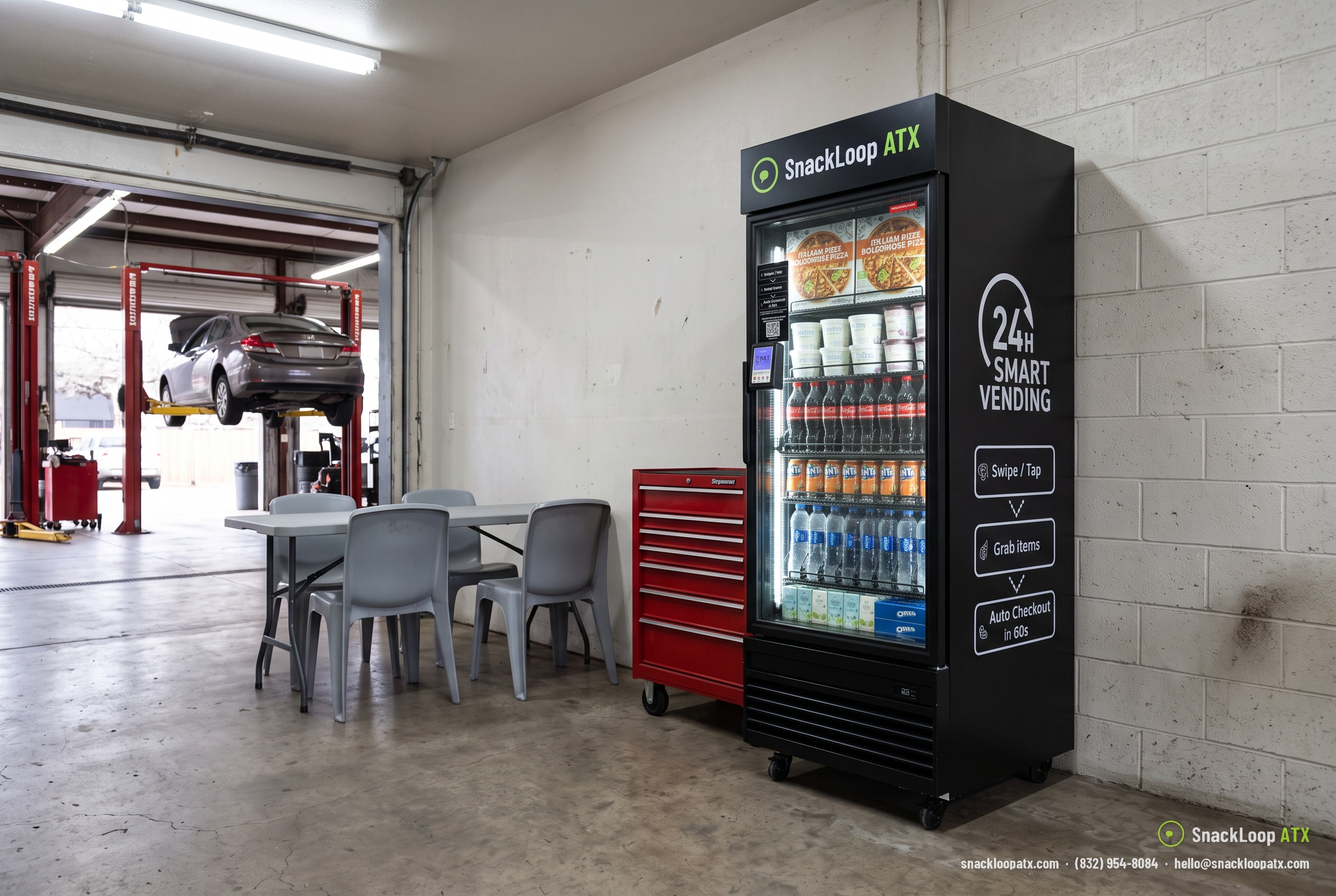
After the clocks change, the end of the working day can fall after dark. Whether it does in your building is something the window will tell you.
This is written for the buildings where it does: warehouses, service bays, clinics with evening hours, sites that run around the clock. In those buildings a machine stands through hours the person who runs the place rarely stands in.
What changes for a machine when the end of the shift falls in the dark?
The hour changes, and the room changes with it.
My own reading, and it is a reading rather than a measurement, is that the last stretch of a shift sits differently once the windows have gone black. You can settle that without me. Stand in the room at the end of a shift in July, then in the same room at the same clock hour in November, and ask whether people move through it the same way.
What I would not claim is that anybody eats differently in November. The claim is smaller and duller than that: the room is not the same room, and the walk across it is not the same walk.
What should you be asking instead of what people eat?
When the gap falls.
The food question is the one that gets asked first, and its answer moves slowly. The hour question is the one that can move under you. A gap is any stretch where somebody has time on their hands and nowhere in particular to be, and a machine sells into a gap.
What is worth knowing in November is where that stretch has landed. Before the last push of the day, or after it? While the office side is still occupied, or once only the working end is lit? That needs no counting, only being in the building at the hour the shift ends.
Is a machine in an unlit corner the same machine after dark?
It is the same box. It is not the same offer.
This is not a security point. The question is duller: whether anybody bothers. A corridor that reads as ordinary while the whole floor is lit can read as the back of the building once some of those lights are off, and a walk somebody took without thinking in July can turn into one they decide against.
So lighting and sightlines are worth a look once the building is dark at the end of a shift, and the only useful time to take that look is the hour the machine is actually used, not the hour that suits a walkthrough.
| What to look at | What you are actually asking |
|---|---|
| The approach | Lit at that hour, or only while the offices are open? |
| Sightlines | Visible from where people pass, or only up close? |
| The glass | Can somebody tell what is inside before walking over? |
| The lights that are off | A timer, a switch somebody flips on the way out, or a forgotten corner? |
| The route out | On it, or a detour away from the door? |
You are looking for one thing: whether the machine is on the way.
Why does leaving the building cost more at the end of a shift?
Because the trip has to beat finishing and going home.
This is our thinking rather than anything we have measured. In the middle of a shift, going out for something costs an errand and the errand can be worth it. At the end of one, the same trip is up against walking to the car, and that is a harder thing to beat. Which is the argument for putting a machine where the last people in the building are, rather than where the crowd is at the busiest hour.
They may not be the same corner. Think of Austin service bays with the doors still up, clinics running evening hours, or warehouses out toward Round Rock where the working day ends long after the office side has gone quiet.
What do you do with what the walk tells you?
A walk like that ends in one of three answers.
The corner is right and the light is not. That is a switch, a timer setting or a bulb, and it belongs to whoever runs the building rather than to the machine.
The corner is lit and still off the route. Then the machine is standing in the wrong place, and that is ours to sort out rather than yours to solve.
Or the corner is right, the light is right, and the walk still does not happen. Then the building may not have a gap where you thought it had one, and knowing that is worth more than a machine standing in a dark corner as furniture.
What does this cost you, and what happens next?
Nothing, and one evening of your own attention.
SnackLoop ATX brings the machine in and installs it, keeps it stocked, restocks it on a regular schedule, and covers service and repairs at our own cost. Your side is floor space and a standard power outlet. Nobody there orders product, counts stock or calls a technician, and everything inside stays ours until somebody pays. People pay by card or contactless tap, checkout closes itself in about 60 seconds, and there is no cash, no coin mechanism and no keypad codes.
Placement terms vary by location, and whichever applies is agreed before installation. There is no long term commitment.
The next evening you are the last one out, take the long way past the machine. Come in from where people come from, stop where they stop, and look at that corner with your coat already on. If the machine is not on that route, that is the thing to fix first.
If you want us to come and look at the space, the application form takes about a minute. And if nothing about that corner or that shelf has changed since the summer, ask whoever services it to take another look. If that goes nowhere, we wrote separately about switching vending providers without a gap in service.
Frequently asked questions
Does it really matter which corner the machine sits in?
It matters more once the building is dark at the end of a shift. A spot that reads as ordinary with every light on can read as the back of the building later, and people tend to walk to what is already on their way. Look at the approach at that hour.
Will the selection change now that the day looks different?
It changes all the time, though not because of the season. We set a mix by putting everything plausible on the shelf and taking off what nobody picks, and snack and lunch items rotate week to week on purpose. Tell us what is sitting and we swap it.
What if people use the machine when nobody from my side is around?
Nothing has to be arranged on your side. Payment is a card or contactless tap with automatic checkout in about 60 seconds, and there is no cash, no coin mechanism and no keypad codes. Nobody on your side has to be there for a sale to happen.
What does the machine need from me, and what does it cost?
Floor space and a standard power outlet. We handle delivery, installation, stocking and restocking on a regular schedule, and we service and repair the machine at our own cost. You are not buying equipment, not managing inventory and not handling money, and no long term commitment holds you to it.
What if the machine turns out to be in the wrong place?
Say so. A machine nobody walks to is worse for you than no machine, because it occupies a corner and looks neglected. It is our equipment and our problem to solve, so if the route people take at the end of a shift misses it, tell us and we will look again.