Vending machine for an office in Austin: how many people do you need?
Enough people have to walk past it on a normal day without an easy alternative a few minutes away. That is the real requirement, and it is why a small warehouse office with nothing nearby can outsell a much larger office suite that has a coffee bar in the lobby. Headcount is the number everyone asks about. How stuck those people are is the number that decides it.
If you want a published figure to start from, one exists: a 2018 guide from Vending Group, a national vending operator, states a minimum of at least 40 full-time employees for an office setting. It is eight years old and it describes their business, not yours, so treat it as a starting point rather than a verdict.
Why do different providers give different minimums?
Because each one is describing the kind of building it happens to serve, without saying so.
A provider working with distribution warehouses is picturing people on a short break who cannot drive anywhere. A provider working with downtown offices is picturing people who can walk to a taqueria before their coffee gets cold. Both may quote a number honestly. Neither number automatically transfers to your building.
So treat any specific minimum you read online with a degree of suspicion, including any number you get from us. The useful question is not what the number is. It is what the number is made of.
What is the actual math?
Every viability estimate in this business, however it is presented, comes down to one line:
daily people × how many of them buy × average purchase × days open per month
The only genuinely uncertain term is the second one, and it moves a great deal depending on the site:
| Type of location | How many are likely to buy on a given day |
|---|---|
| Warehouse or plant, shift work, nothing within walking distance | High |
| Clinic, service waiting room, laundromat, where people are stuck waiting | High |
| Office with no café or canteen within a short walk | Moderate |
| Office with a café in the building or next door | Low |
| Apartment lobby, where everyone has a kitchen upstairs | Very low |
We have deliberately left percentages out of that table. Anyone who gives you a precise rate for a building they have never seen is guessing, and a decimal point does not turn a guess into a measurement. What the table does give you is the ranking, and the ranking holds: the fewer the alternatives and the longer the wait, the more a machine sells.
What should you look at instead of headcount?
How many people are actually in the building on a Tuesday? Not the payroll figure. Hybrid schedules mean the number on the org chart and the number in the breakroom are often different, and the machine only ever sees the second one.
How long does it take to buy a snack somewhere else? Walk it and time it. A short walk to real food is real competition. A long one, or one that crosses a parking lot in an Austin August, is not.
Are there shifts? Shifts stack. Three crews of 20 are 60 people past the machine in a day, and the night crew usually has the fewest alternatives of anyone in the building. That is truer in the warehouses out toward Pflugerville and Round Rock than it is downtown.
Does anyone wait? A service department where customers sit for an hour, a clinic waiting room, a laundromat. Dwell time does what headcount cannot. People with nothing to do and nowhere to go buy things.
What if your site is on the small side?
Being under a published threshold does not automatically mean no. Often it means a different machine.
A slim drinks cooler needs far less throughput to make sense than a full combo unit, and suits a small office or a waiting room that would never justify a large machine. It is also worth asking the question rather than assuming: the answer depends on the survey, not on the org chart.
If a location is unlikely to work, the right thing is to say so before installing anything. A machine nobody uses is worse for you than no machine. It looks neglected, and it occupies a corner of your breakroom for nothing.
What does it cost you?
Nothing. That is the part most property managers assume has a catch, so here it is plainly.
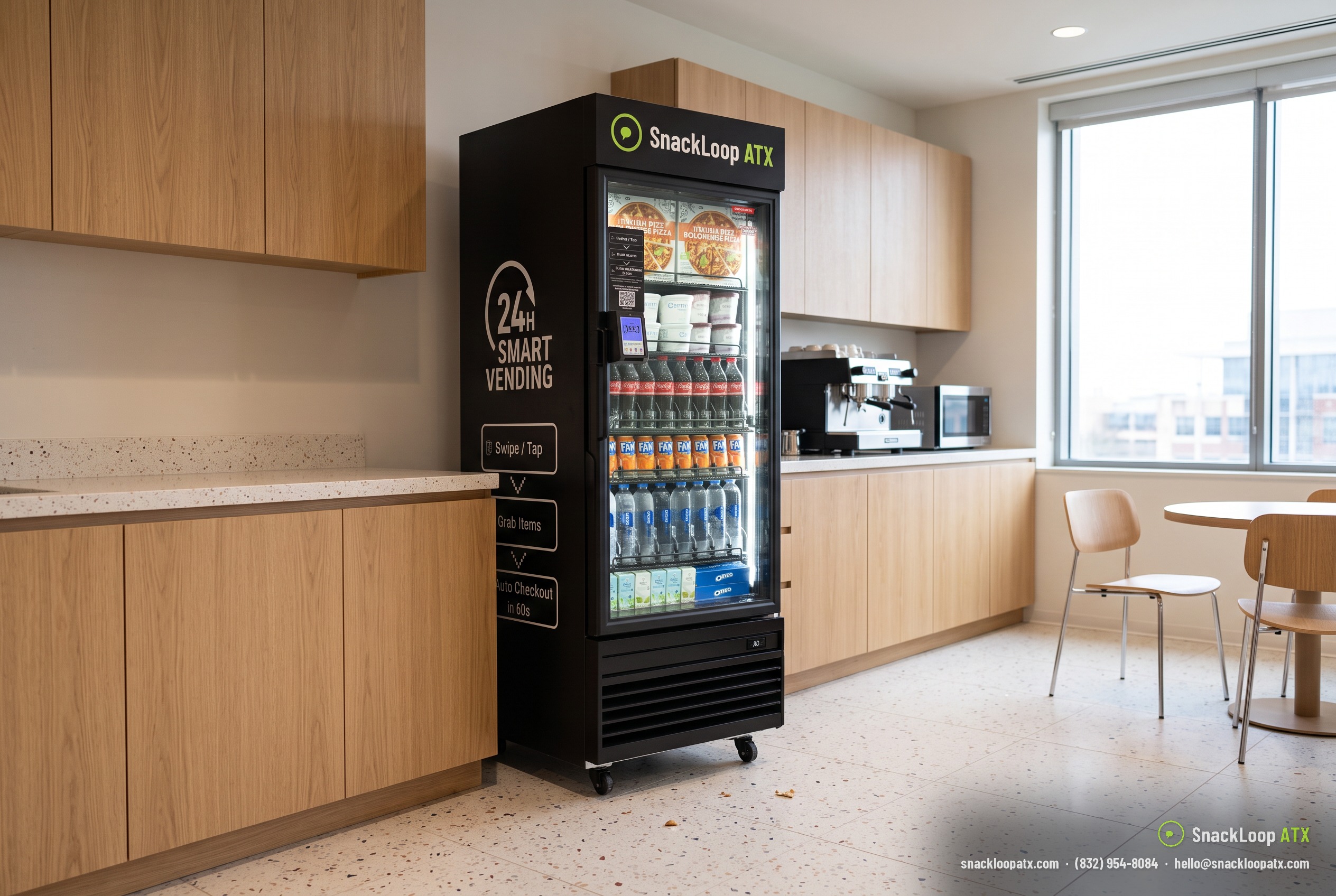
SnackLoop ATX delivers and installs the cooler, stocks it, restocks it on a regular schedule, and services and repairs it at our cost. You provide the floor space and a standard power outlet. You are not buying equipment, not managing inventory and not handling money. Every purchase is a card or contactless tap at the machine, with automatic checkout in about 60 seconds.
Placement terms depend on the location. They are agreed before installation. There is no long-term lock-in. If you would like us to look at your space, the application form takes about a minute.
And if you already have a machine that sits half-empty, that is a different problem with a different answer. We wrote about switching vending providers without a gap in service separately.
So what should you actually do?
Do not start with a headcount. Start with a Tuesday. Count who is actually in the building, walk to the nearest place they could buy a cold drink and time it, and note whether anyone is stuck waiting. Those three observations will tell you more than any minimum you can look up, including the one at the top of this page.
Frequently asked questions
Is a vending machine really free for my business?
Yes. We supply the machine, install it, stock it and maintain it at our own cost, and there is no equipment purchase, lease or service fee at any point. You provide floor space and a standard outlet. Placement terms depend on the location, and there is no long-term lock-in.
How many employees do I need before it is worth it?
There is no single number that fits every building. One published example is Vending Group's 2018 figure of 40 full-time employees for an office, but a site with fewer people and no nearby alternatives can perform better than a larger one next to a cafe. Daily occupancy, walking distance to food, shifts and waiting time all matter.
What if my office is too small for a full-size machine?
A slim drinks cooler needs considerably less traffic to make sense than a full snack-and-drink combo unit, so small offices and waiting rooms that could not support a large machine are often still worth surveying. The right answer depends on the space and the traffic, which is what a site visit is for.
Who restocks it, and do I have to manage anything?
We do, on a regular schedule, and you manage nothing at all. You never order stock, count inventory, handle product or deal with suppliers. If something is selling out faster than expected or not moving, that is ours to notice and ours to fix, at no cost to you.
How do people pay, and what happens if it breaks?
Payment is a card or contactless tap at the machine, with no cash, no coin mechanism and no keypad codes, and checkout completes automatically in about 60 seconds. If the machine develops a fault, we service and repair it at no cost to you. It is our equipment and our responsibility.