A clinic has two waiting rooms, and only one of them has chairs
A clinic earns a machine because nobody there can leave. A patient whose appointment is running behind cannot walk out for a coffee without risking their place in the queue, and staff working through a shift change rarely get a break long enough to go anywhere either. That is two separate groups, in one building, both stuck. Dwell time, not the size of the practice, is what makes the machine work here.
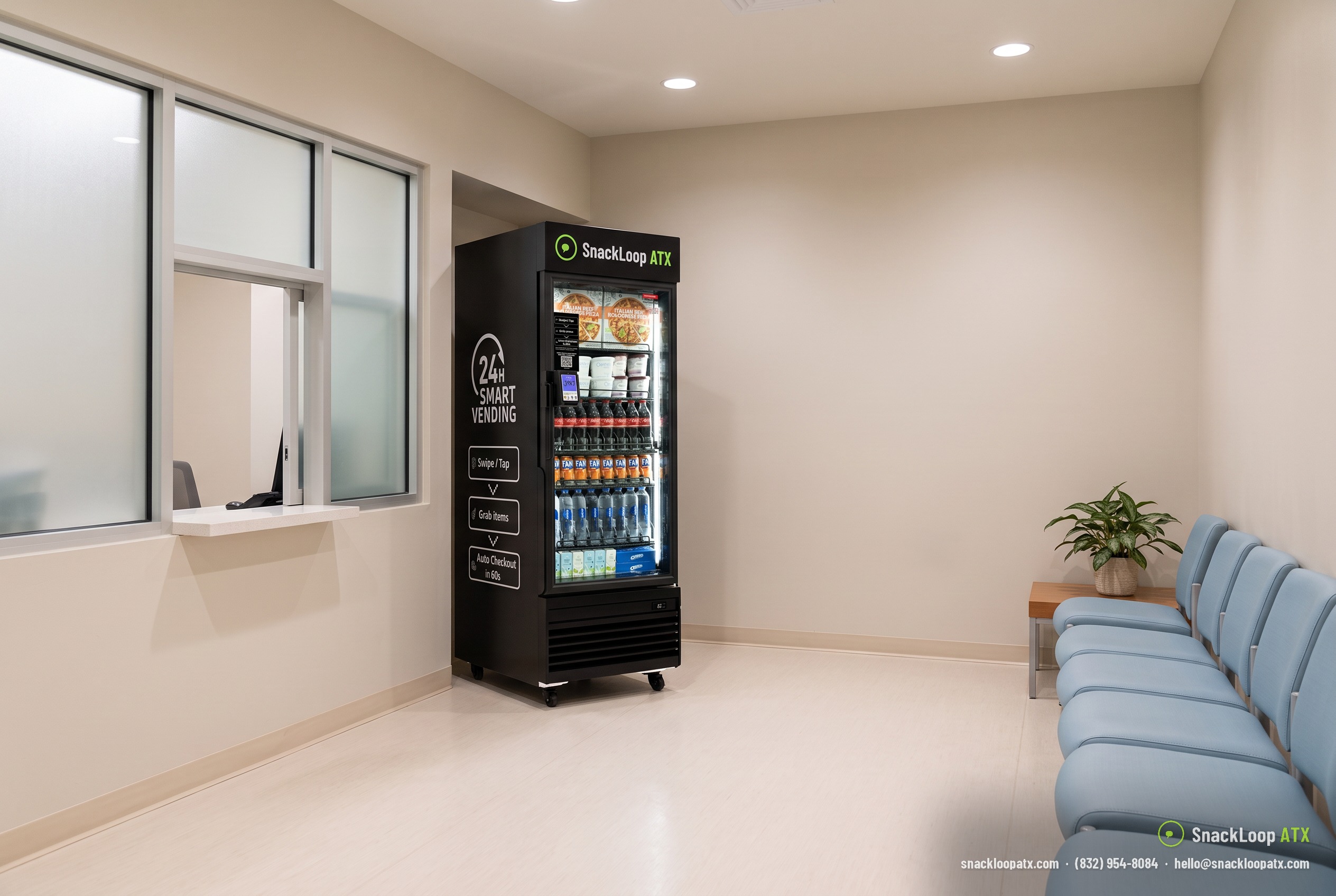
A clinic is one of the few buildings where the people who cannot leave are sitting in plain sight, in a row of chairs.
Who is the machine actually for in a clinic?
Two groups, and they are not the same customer.
The first is in the waiting room. A patient is there for an appointment, and if it runs behind, they wait. Walking out to find something to eat means giving up their place in the queue. A parent waiting with a child has even less room to move: whatever the child needs, they need it in that room, and the parent cannot leave to get it.
The second group is on the other side of the door. Front desk staff cannot step away while there is a line. Clinical staff move between rooms in whatever gap the schedule leaves, and a shift change is a handover rather than a break. Their constraint is not the queue; it is that their day has no fixed hole in it.
| Who is standing in front of the machine | Why they are there rather than somewhere else |
|---|---|
| A patient whose appointment is running behind | Leaving costs them their place in the queue |
| A parent waiting with a child | The child needs something now, and the parent still cannot go |
| Front desk staff | Cannot walk away from a waiting room with people in it |
| Clinical staff between patients | The gap is whatever the schedule leaves, and it is not planned |
| Anyone working a shift change | A handover is not a break, and the day may not offer another |
Two demand curves in one building, running on different clocks.
Why does dwell time matter more than the size of the practice?
Because headcount tells you how many people pass through; dwell time tells you how long they are stuck once they arrive.
It is the same argument as an auto shop service lounge. The customer's car is on a lift, or the patient's name is on a list, and either way leaving costs them something. A large practice where everybody is in and out quickly gives a machine less to work with than a smaller one where people sit.
Austin makes the second half of that argument for us. If your clinic sits on a frontage road with the nearest coffee across a parking lot, then in August "there is a place nearby" is technically true and practically useless. Nobody sitting in a gown is walking it.
Does a vending machine belong in a medical waiting room?
It is a fair thing to worry about, and the answer is not automatically yes.
A waiting room is designed to feel calm and unhurried. A large illuminated unit facing the chairs works against that; a slim cooler beside the coffee station, or one set into an alcove off the main sight line, does not. The object matters as much as the idea.
Two details help more than they sound like they should. Payment is card or contactless only, with no cash, no coin mechanism and no keypad codes, so there is no rattle of change and nobody feeding dollar bills in while others wait; checkout completes automatically in about 60 seconds. And there is nothing to manage on the clinic's side, so it never becomes a task the front desk quietly inherits.
There are also clinics where the honest answer is no. A lab or a pre-operative area where patients have been told to fast should not be putting food in front of them. A dental practice may not want anything between the chair and the door for someone who has just had work done. Those are reasons to put it on the staff side, or to leave it out, and they are better said at the survey than discovered afterwards.
Should the mix lean away from confectionery in a health setting?
That is the clinic's call, and worth making deliberately.
A room whose entire purpose is health has an opinion about what is on display in it, and a dental practice has a particularly obvious one. The mix is agreed before installation, so a clinic that would rather lead with water, unsweetened drinks, nuts and protein items can have exactly that, and one that wants sticky sweets left out altogether can have that too.
What we will not do is tell you in advance what your building will buy. We can set the shelves to match the room; what comes off them is decided by the people in it.
What does the staff side need that the waiting room does not?
Access at the hours the schedule actually runs.
The waiting room empties when the clinic closes. The staff side does not always. People finishing charts, covering an evening block or handing over to the next shift are on site at hours when the options around the building thin out, and for them a machine inside is the difference between something and nothing.
Placement follows from that. A machine in the waiting room serves patients; one in a staff corridor serves staff. A machine where the two paths cross (the hallway past the front desk, a break area backing onto reception) can serve both, and whether that geometry exists in your building is what a site visit is for.
What does the clinic have to do?
Provide floor space and a standard power outlet. That is the whole list.
We deliver and install the machine, stock it, restock it on a regular schedule, and service and repair it at our own cost. Nobody at the clinic orders product, counts inventory, handles money or calls a technician. There is no equipment purchase, no lease and no service fee, and no long-term lock-in.
Terms for hosting depend on the location. The terms depend on the location and are agreed before installation. They are agreed before anything is installed, not after. If you would like us to look at your waiting room, the application form takes about a minute.
And if there is already a machine in the lobby that patients and staff have quietly stopped using, that is a different problem, which we cover in switching vending providers without a gap in service.
Frequently asked questions
Does a vending machine fit the tone of a medical waiting room?
That depends on the machine and on where it stands. A slim cooler beside the coffee station reads very differently from a large illuminated unit facing the chairs. Payment is card or contactless with no coin mechanism, so there is no rattle of change. If a particular room is wrong for it, we would rather say so at the survey.
Should a clinic machine avoid candy and sweets?
It can. The mix is agreed with the clinic before installation, so a practice that would rather lead with water, unsweetened drinks, nuts and protein items can have exactly that, and a dental office can leave sticky sweets out altogether. That is a decision worth making at the survey rather than arguing about a shelf later on.
Do we pay for the machine, or does it pay us?
Neither is automatic. The terms depend on the location and are agreed before installation. Which one applies depends on the location and is agreed before installation. There is no equipment purchase, lease or service fee at any point.
Who restocks it, and what happens if it breaks?
We do, on a regular schedule, and nobody at the clinic orders product, counts inventory or handles money. We deliver, install, stock, restock, service and repair the machine at our own cost. The clinic provides floor space and a standard power outlet, and there is no long-term lock-in of any kind.
Should it go in the waiting room or on the staff side?
That depends on which group you are trying to reach, and on whether one machine can reach both. A spot where patient and staff paths cross serves two groups at once. A machine behind a badge-only door serves one of them. Working out whether that geometry exists in your building is what a site visit is for.