Does a vending machine make sense in a retail store?
Usually not, if you already sell cold drinks at your own register, because then the machine is competing with you rather than with anything else. It changes in three situations: a store that sells something else entirely and has no food or drink on site, a store where people stay long enough to get thirsty, and staff who cannot leave the floor. Here is how to tell which one you are.
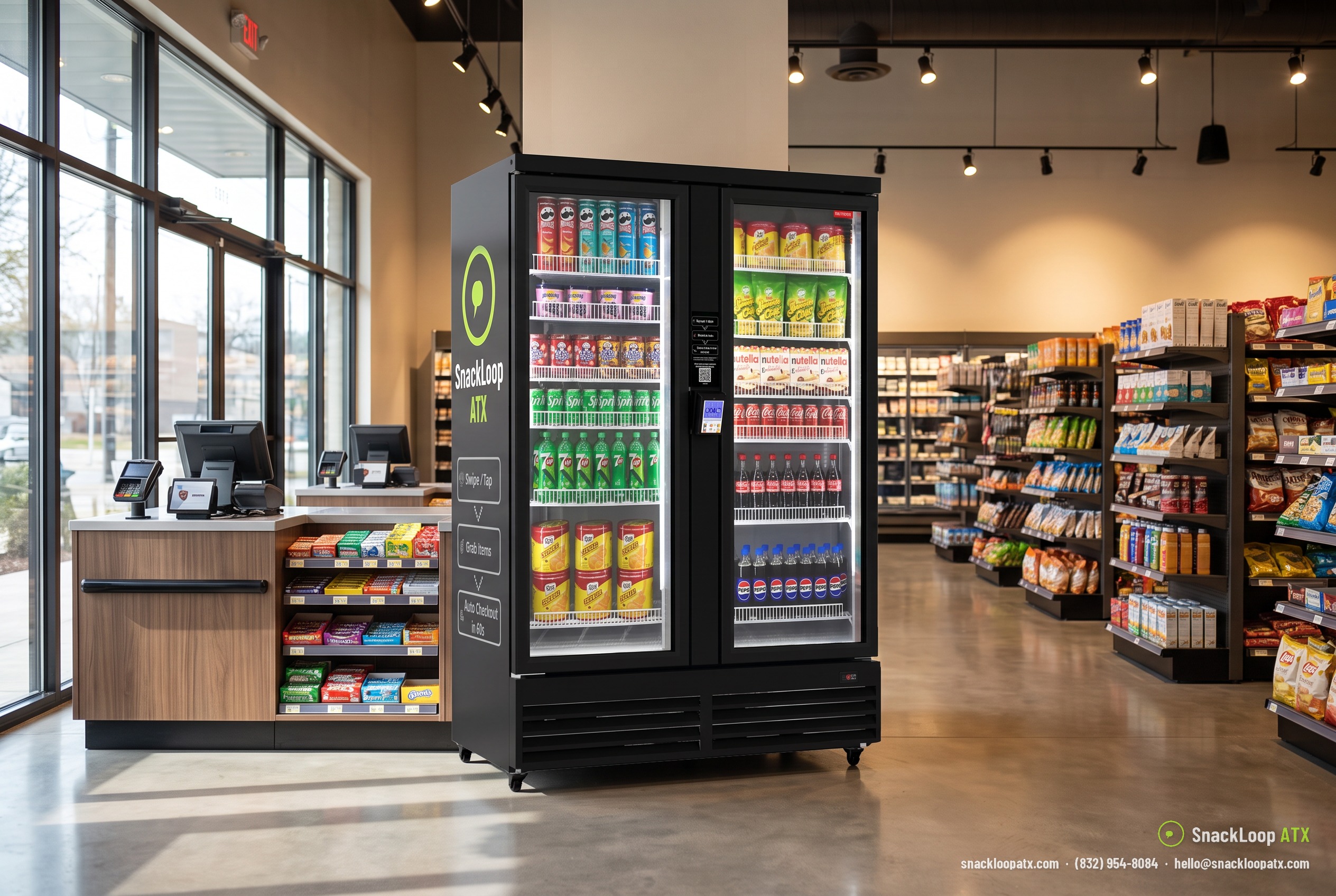
Retail is the one venue where the objection writes itself: why would a store owner give floor space to somebody else's drinks? That deserves a straight answer first.
Are you not just competing with your own cooler?
If you sell cold drinks at the register, yes, and there is no nice way around it.
A store with a cooler by the till has already solved the problem a vending machine solves, and in a better place: right where the customer stands with a wallet already out. A machine a few steps away does not conjure up a thirsty customer. It moves a sale you were going to make anyway from your side of the counter to ours.
So for a convenience store, a gas station shop, a corner market or a cafe with a drinks case, the answer is no, and we would rather say it now than after something is installed. The rest of this is about the stores where that competition does not exist.
What kind of store does not compete with itself?
One that sells something you cannot eat or drink.
Furniture and mattress showrooms, flooring and tile, apparel, hardware, appliances, craft stores, auto parts counters. None of them are in the drinks business, so there is nothing to cannibalise. The question is not "retail, yes or no". It is whether the store already sells the thing.
| What the store is like | How to reason about it |
|---|---|
| Convenience store, gas station shop, any cooler at the register | No. The machine competes with the owner |
| Furniture, flooring, mattresses: long consultations, nothing to eat | Worth a look. People are held in place with no alternative |
| Apparel with fitting rooms, people waiting on someone else | The argument is dwell time, not the door count |
| Staff-only back room, floor coverage that cannot be left | The buyer is your own team, not the customer |
The right-hand column is reasoning, not a forecast.
Does anyone stay in the store long enough to want a drink?
Foot traffic and dwell time are different numbers, and only the second one matters here.
Someone who walks in for one item, pays and leaves was never still. What produces a purchase is time spent standing around with nothing to do: a customer working through a sample rack while somebody takes measurements, a person waiting outside a fitting room, a family that brought a bored kid along because there was nowhere to leave them.
You can run that test yourself: how long does the longest visit of the day last, and does that person have anything to do while it happens? If everyone is in and out, that is your answer, and door traffic will not fix it.
Who buys when the customer is not buying?
Your own staff, and they are the buyer almost everyone forgets.
An associate cannot leave the floor. If two are on shift and one steps out, the store is running on one, and nobody crosses a strip-center parking lot in an Austin August while the register is short. That leaves whatever they carried in that morning, for the length of a shift.
Which is why the back room is often the stronger case, not the weaker one. A machine there serves people who are genuinely stuck, shoppers never see it, and the sales floor is unchanged.
What about the hours when the counter is closed?
Some retail space stays occupied long after the selling stops.
A store that hosts evening classes still has people in it. So does a showroom that opens by appointment, a repair bench behind a closed floor, or a team doing inventory after hours. In those hours your register serves nobody, and whoever is inside has nowhere to buy anything.
An unattended machine does not care what time it is: a card or contactless tap, automatic checkout in about 60 seconds, no cash, no coin mechanism, no keypad codes. If your Austin storefront is still occupied after the register closes, that is time a machine covers and your counter does not.
What does the store actually have to provide?
Floor space and a standard power outlet. That is the entire list.
SnackLoop ATX delivers and installs the machine, stocks it, restocks it on a regular schedule, and services and repairs it at our own cost. You are not buying equipment, ordering product, counting inventory or handling money, and there is no long-term lock-in. Placement terms vary by location and are agreed before anything is installed.
If you want us to look at your space, the application form takes about a minute. And if there is already a machine in your store sitting half empty, that is a different problem with its own answer, covered in switching vending providers without a gap in service.
So, in order: do you sell drinks already, does anyone stand still in your store, and can your staff leave the floor. If the first answer is yes, stop there. If not, the other two are worth an afternoon of watching your own shop.
Frequently asked questions
Will a vending machine compete with the drinks I already sell?
If you sell cold drinks at your register, yes, and we would say so before surveying anything. The machine does not create a thirsty customer who was not already in the store; it moves a sale from your side of the counter to ours. Convenience stores are a poor fit.
What kind of retail store is actually a good fit?
One that sells something you cannot eat or drink, and where people stay a while. Furniture and mattress showrooms, flooring and tile, apparel with fitting rooms, hardware, appliances, hobby and craft stores, auto parts counters. There is no cooler to compete with, and consultations and browsing give a customer time to want something cold.
Should the machine go on the sales floor or in the back room?
That depends on who you want buying from it. On the floor it serves customers who are waiting or browsing, so it has to suit the look of the room. In the back room it serves only staff, stays out of sight of shoppers, and changes nothing about how the store presents itself.
Do we pay for the machine, or does it pay us?
Neither is automatic. The terms depend on the location and are agreed before installation. Which one applies depends on the location, and it is agreed before installation rather than discovered afterwards.
How do people pay, and who fixes it if it breaks?
Payment is a card or contactless tap at the machine, with no cash, no coin mechanism and no keypad codes, and checkout completes automatically in about 60 seconds. If the machine develops a fault, we service and repair it at our own cost. It is our equipment, not yours.