The teachers' lounge is a workplace. Anywhere students reach is not.
A teachers' lounge is a straightforward workplace placement, and it is the only placement this article is about: the machine goes behind the staff door, not in a hallway, a cafeteria or a gym lobby. Anything a student can reach is a different decision, governed by the district, and not something we propose. What makes the lounge unusual is a bell-timed break and a summer that empties the building.
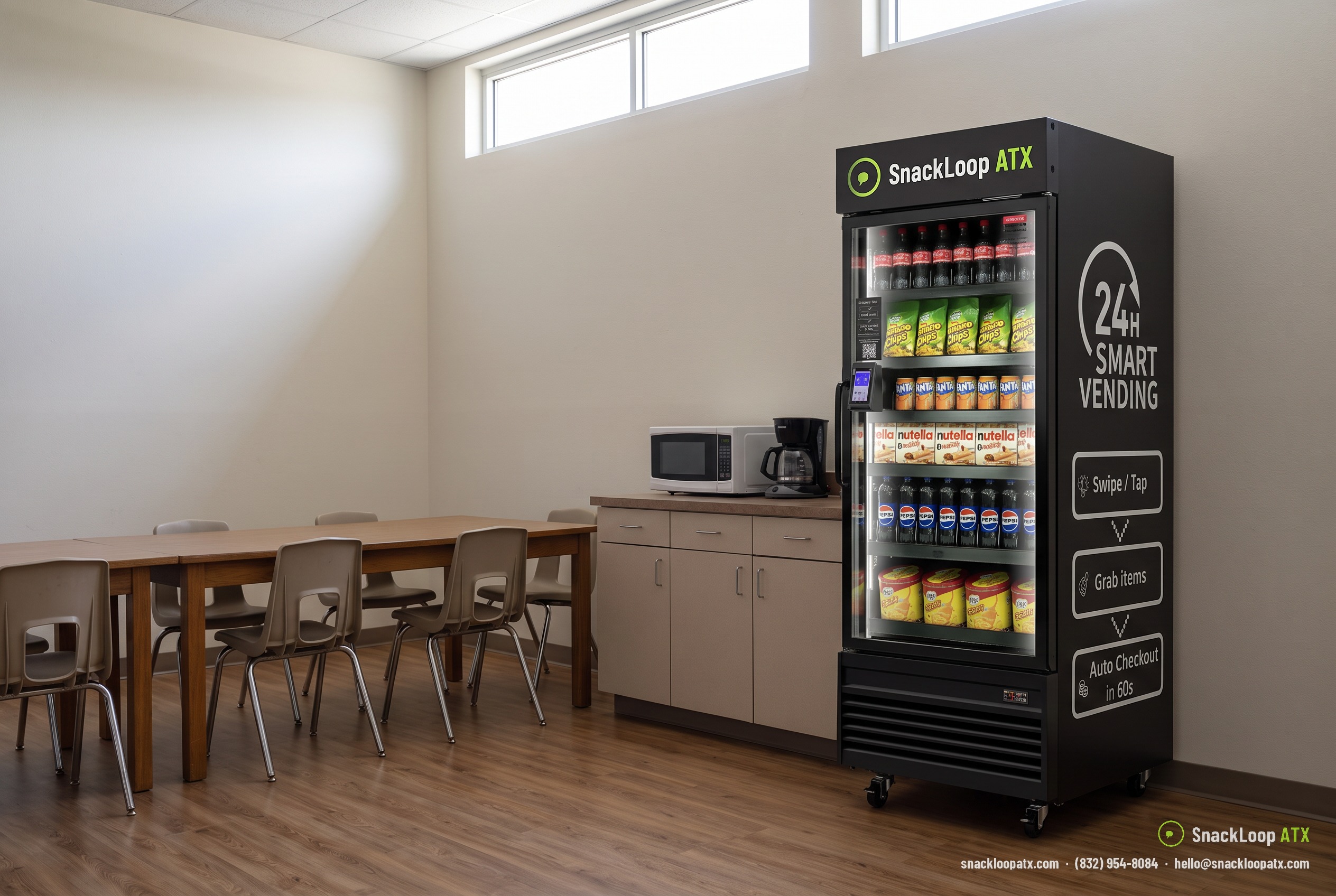
Before anything else: the machine goes in the staff lounge, behind the door students do not walk through. Not the hallway, not the cafeteria, not the gym lobby. That distinction decides everything else here.
Why does staff lounge versus anywhere students reach decide everything?
Because those are two decisions with different owners.
A staff lounge is a workplace break room that happens to sit inside a school: adults at work, on a break, in a building they cannot casually leave. That is the same shape as an office breakroom, and it is judged the same way.
Put the same machine where a student can reach it and the question changes hands: what may be sold on a campus, who signs off, which nutrition rules apply. Those are the district's rules to interpret, not a vending company's, and we are not proposing to touch them.
| Where the machine sits | Whose decision that makes it |
|---|---|
| Staff lounge, adults only, door students do not use | The school's own facilities decision, like any workplace break room |
| Staff workroom that also opens onto a corridor students use | Worth resolving before installation rather than after |
| Hallway, cafeteria, gym lobby, anywhere a student can reach | The district's, under its own approval and nutrition rules. Not what we propose |
The middle row is worth walking in person: a lounge with a second door, or a workroom that opens onto a corridor at dismissal, is staff-only in theory and something else in practice.
What is different about a break that runs on a bell?
It is short, it starts when the bell says so, and it ends the same way.
An office break is elastic: you can stretch it, walk somewhere, move it because a meeting ran over. A lounge break is none of those. Whatever its length on your bell schedule, it is fixed, it arrives when somebody else decided, and what stops you is the clock rather than the distance.
That leaves a short list: what somebody packed at home that morning, what is left in the staff fridge, or nothing until the last bell. I find a school schedule easier to read than an office one for that reason, and on an Austin afternoon in August nobody is crossing an open parking lot for a cold drink anyway.
Where in the lounge does the machine actually go?
Where people already stand still: near the coffee maker or the sink, not in a doorway and not where it makes a bottleneck when the bell just went.
The rest is footprint. If the room already carries a refrigerator, a copier, mailboxes and a table people eat at, the honest question is what it can give up: sometimes a full snack-and-drink combo unit, sometimes a slim drinks cooler against one wall, with a standard power outlet within reach.
What happens when the building empties for the summer?
It goes quiet, and the time to talk about that is before installation, not in July.
A school has a stretch every year when the people it was built for are not in it. That is not a reason to say no, but a reason to plan out loud.
Restocking should follow the school calendar. We restock on a regular schedule, and that schedule can be built around a school year rather than against it. Filling a machine to the top the week before a long break is a deliberate decision.
Which weeks are genuinely empty, and who is still on site? Summer programs, office staff, maintenance crews and teachers setting up rooms are not a full building, but they are not nobody. Whoever keeps the building calendar knows; anyone outside the school is guessing.
If the cooling is set back over the break, say so beforehand. A machine standing in an unconditioned room through a Texas July changes what belongs inside it and whether to leave it loaded.
What does the school actually have to do?
Provide floor space and a standard power outlet. That is the whole list.
SnackLoop ATX delivers and installs the machine, stocks it, restocks it on a regular schedule, and services and repairs it at our own cost. Nobody on staff orders product, counts inventory or calls a technician. Payment is a card or contactless tap with automatic checkout in about 60 seconds, and with no cash, no coin mechanism and no keypad codes, no cash box sits in a room.
Terms depend on the location. Whichever applies is agreed before installation, and there is no long-term lock-in. If you would like us to look at the room, the application form takes about a minute. If a machine is already in the lounge and staff have quietly given up on it, that is covered in switching vending providers without a gap in service.
So what should you check before you ask?
Three things, and all three fit in one afternoon.
Work out honestly who can get into that room, including at dismissal and during after-school activities. Read the bell schedule and the room together: how long the break is, how many arrive at once, which wall is free. Then find the summer weeks when nobody is in the building. For a campus in Austin or the districts around it, those answers beat any headcount.
Frequently asked questions
Is this a machine students would use?
No. This is a staff lounge placement, behind the door students do not use, and it is the only thing proposed. A machine students can reach is a different decision, governed by the district under its own approval and nutrition rules, and not one we ask anyone to open.
How do teachers pay for something?
With a card or a contactless tap at the machine, and checkout completes automatically in about 60 seconds. There is no cash, no coin mechanism and no keypad codes, so nobody hunts for quarters on a short break and no cash box sits in a room in the building.
What happens over the summer, when the building is empty?
That is worth agreeing on before installation rather than discovering it in July. Restocking runs on a regular schedule, and that schedule can be built around a school calendar. The school tells us which weeks are genuinely quiet, who is still on site and whether the building stays cooled.
Who restocks it, and who fixes it if it jams?
We do, on both counts. We deliver, install, stock, restock on a regular schedule, and service and repair the machine at our own cost. Nobody on staff orders product, counts inventory, handles money or calls a technician. The school provides floor space and a standard outlet.
Does the school pay for this, or get paid for it?
It depends on the location, and it is agreed before installation rather than afterwards. The terms depend on the location and are agreed before installation. There is no long-term lock-in.