Warehouse vending: why the same machine sells differently than in an office
Stock for the break, not for the building. A warehouse break is short, starts at a fixed time, and leaving the site eats all of it, so what sells is cold, filling and fast to open. An office break stretches and has options a few minutes away, so the same cooler ends up selling something small in the afternoon instead. The machine does not change. The break does.
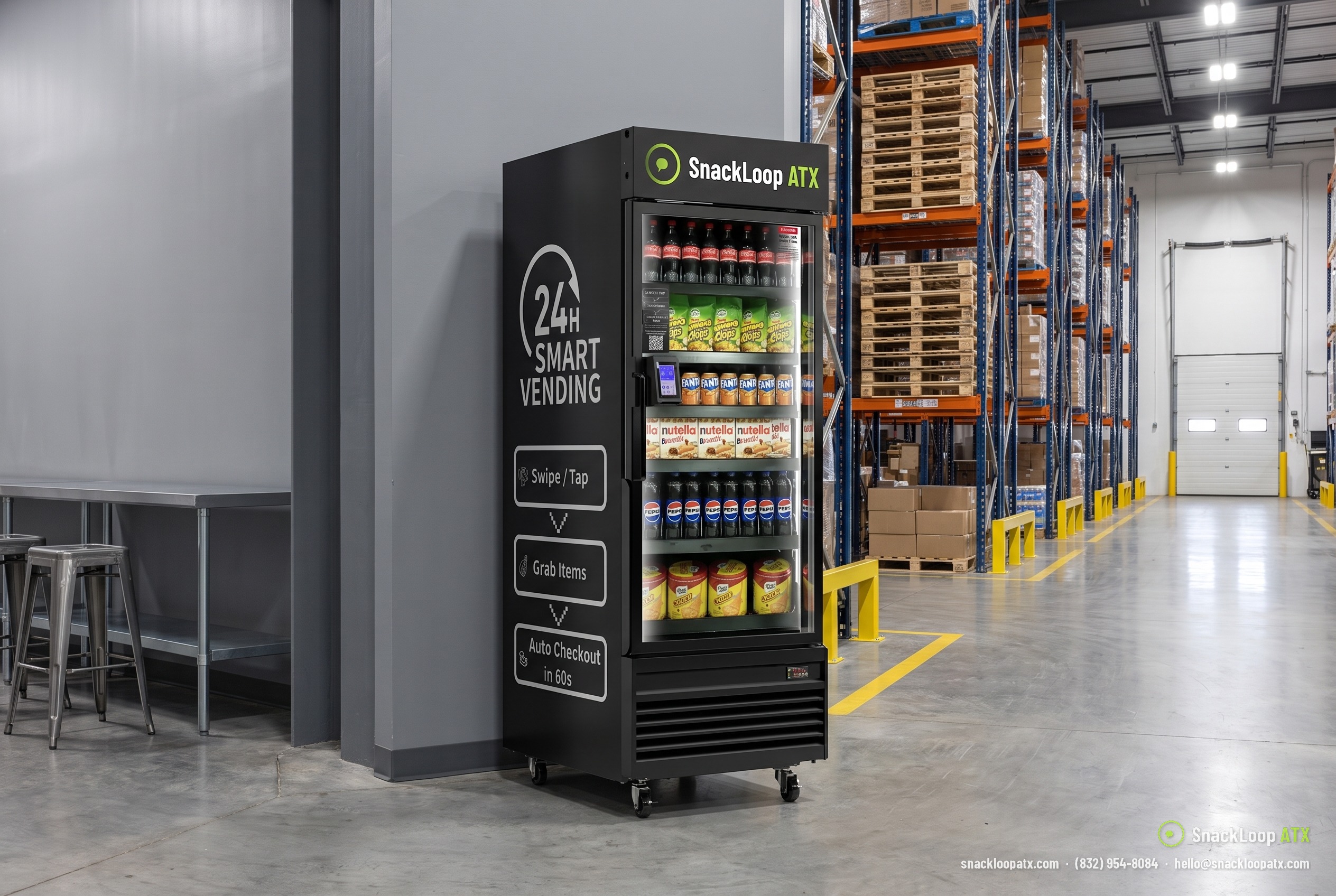
I find warehouses easier to think about than offices, because almost everything that decides how a machine performs is visible from the floor in ten minutes.
Why does the same machine sell differently here?
Because the break is different, and the break is what people are buying inside.
An office break is elastic. Somebody stretches it, walks out, gets a coffee, comes back. What they buy from a machine is a small addition to a day that already has options in it.
A warehouse break is fixed. It starts when it starts, it is short, and leaving the building is usually not realistic. Not because anyone forbids it, but because the round trip eats the whole break. So the purchase has to do a job: cool you down, fill you up, and be finished before you are back on the floor.
That is why the same cooler, with the same shelves, ends up selling cold drinks and substantial items in one building and sparkling water and a small snack in another.
What does physical work change about demand?
Two things, and both are simple.
Heat pulls everything toward drinks. In an Austin summer a warehouse without heavy air conditioning is a hot place to spend eight hours, and thirst is not a preference, it is a requirement. Water, electrolyte drinks and cold soda do the work that coffee does in an office.
Effort pulls everything toward filling. Someone doing physical work through a shift is not looking for something to nibble at their desk. They want the break to count.
There is a third, quieter factor: the packaging. If a wrapper needs two hands and a table, it loses to something that opens in one motion while walking back.
How do shifts change the arithmetic?
They stack, and this is the part most people underestimate.
A site with a single crew of 60 has 60 people passing the machine. A site with three crews of 20 also has 60. But they are spread across the whole day, which means the machine is earning at hours when the building is otherwise quiet.
The night crew deserves particular attention. At two in the morning the useful question is what is still open near your building and how far it is. That is worth checking for your own address rather than assuming. Out in the distribution corridors toward Pflugerville, Round Rock and Del Valle the honest answer is often "not much". For a crew in that position the cooler stops being the convenient option. A second or third shift is worth raising at the survey rather than treating as a footnote.
Where should the machine actually stand?
Next to where people already stop.
The break table, the time clock, the locker area: anywhere the day already forces a pause. A machine in the natural path gets used without anyone deciding to use it.
The common mistake is placing it where it looks tidiest: near the front office, off the main floor, in a corridor nobody walks through except at shift change. That machine is easy to walk past, and after a month it reads as a bad idea rather than a badly placed one.
Two practical constraints go with that. It needs a standard power outlet, and it needs to be clear of forklift routes: in the break area, behind the safety line, never on the traffic side of it.
| Placement | Whose path does it sit on |
|---|---|
| Beside the break table | Everyone already stops here; no detour to reach it |
| At the time clock | Every crew passes it entering and leaving, shift change included |
| Front office lobby | Off the floor crew's route; reaching it is a deliberate trip |
| A corridor off the main floor | Nobody walks it without a reason to |
What does hosting one cost the warehouse?
Nothing, and there is no version of this where the building pays.
SnackLoop ATX delivers and installs the machine, stocks it, restocks it on a regular schedule, and services and repairs it at our cost. The warehouse provides floor space and a standard power outlet. Every purchase is a card or contactless tap with automatic checkout in about 60 seconds, so nobody is handling cash and no one on your side is managing inventory.
Placement terms depend on the location, and there is no long-term lock-in. If you want us to look at your floor, the application form takes about a minute.
If there is already a machine in the break area and it is half-empty more often than not, that is a different conversation. We cover it in switching vending providers without a gap in service.
So what should you look at first?
Walk your own break area at shift change and watch where people stop. Then check what time your last crew leaves and what is open near the building at that hour. If the answer is nothing, you already know why the cooler will earn its place.
Frequently asked questions
What should a warehouse vending machine be stocked with?
Lean cold and filling: water, electrolyte and sports drinks, sodas, energy drinks, plus items that work as a real break rather than a nibble. Warehouse crews eat standing up in a short window, so packaging that opens in one motion beats anything that needs assembling. We adjust the mix from what actually sells at your site.
Does a night shift make a machine worth it?
It can matter more than the day shift, for a simple reason: at night there is less open nearby, the drive is longer and the break is just as short, so a cooler on site stops being the convenient option. Two or three shifts also stack the headcount, since every crew passes the same machine.
Where in the warehouse should the machine go?
Next to where people already stop: the break table, the time clock, the locker area. A cooler placed by the front office because it looks tidier there will be walked past rather than used. It also needs a standard power outlet and enough clearance for the door to open fully.
Is it safe on a warehouse floor with forklift traffic?
It should never be on the traffic side of a safety line. Placed in the break area, behind the painted boundary and out of aisle routes, it is no different from a refrigerator or a coffee station. We look at that during the survey rather than leaving it to chance.
What does it cost the warehouse to host one?
Nothing. We deliver, install, stock, restock on a regular schedule, and service and repair the machine at our cost. You provide the floor space and a standard power outlet, and the placement terms depend on the location. There is no long-term lock-in on your side either.