Who pays for the electricity a vending machine uses?
The host pays for the electricity. The machine plugs into your outlet and runs on your meter, the same way everything else plugged in around it already does. Everything else is ours: the machine itself, delivery, installation, stocking, restocking, service and repair. If the power draw is a real concern for your building, that is a conversation worth having before we install, not after.
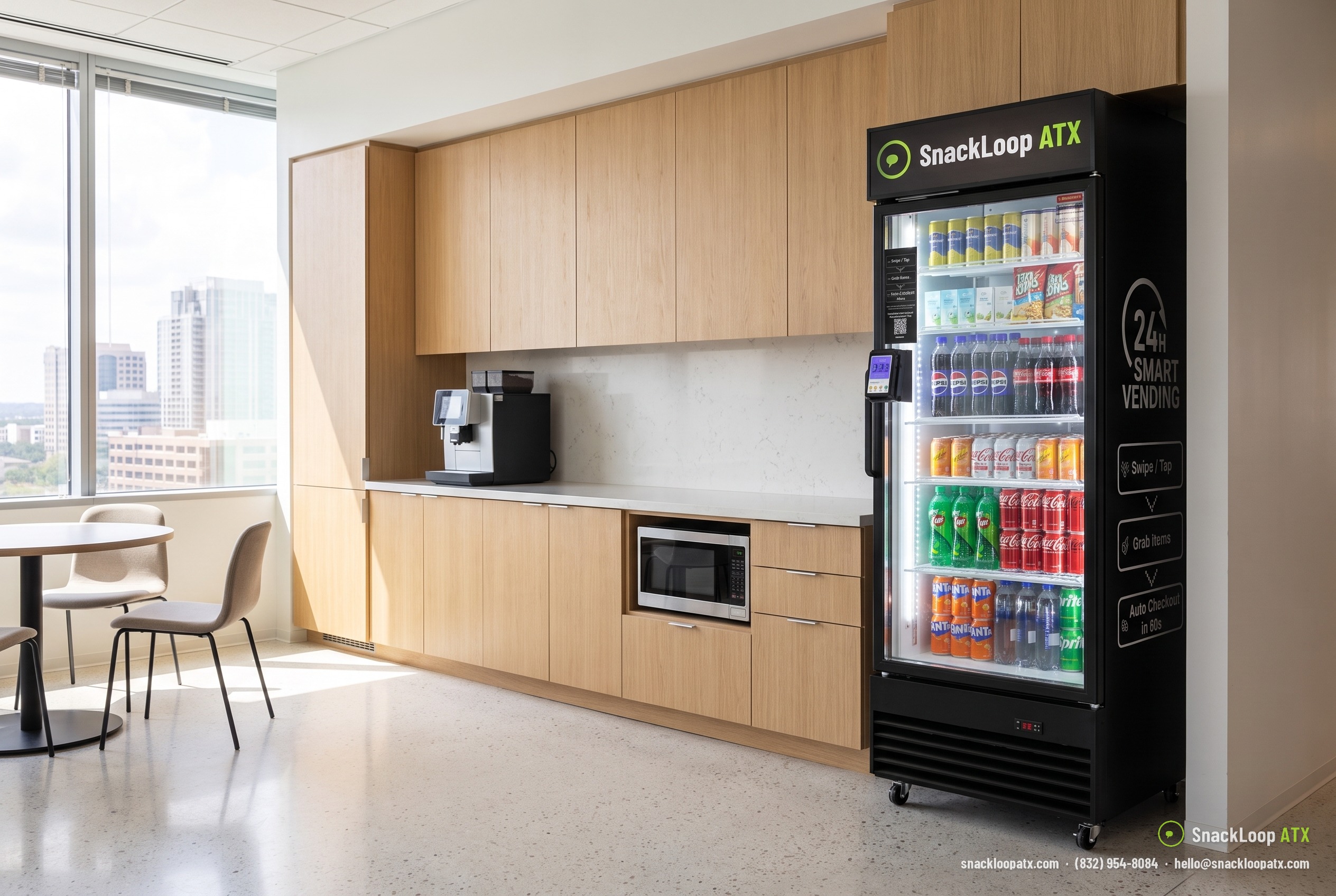
If the machine is free, the fair next question is what it does to the power bill. Here is the straight answer.
Who actually pays for the electricity?
You do. The machine plugs into an outlet in your building, so the power it draws is metered by your building and lands on whoever opens that bill.
Everything on the other side of the ledger is ours. We deliver and install the machine, stock it, restock it on a regular schedule, and service and repair it at our own cost. What you provide is floor space and a standard power outlet.
So electricity is the one running cost that sits on your side. Delivery, installation, stocking, restocking, service and repair are on ours, and the machine and the stock inside it stay ours until somebody pays. That is exactly why the power is worth pinning down before installation rather than discovering it later on a statement.
How much power does a vending machine use?
We are not going to give you a number, because we do not have one that would mean anything for your building.
Here is what can be said honestly instead. We have not measured any of this, and we are not going to describe your machine's draw as though we had. What we can put in your hands is the rated draw printed on the model that would go in your space. What that turns into over a month is a question for the person who reads your panel and your rates, not for us.
So ask us for that model and its rated draw before installation, and take it to your electrician or facilities contractor. Then look at your own bill: a month before against a month after will tell you more than any estimate we could write down.
Who in your building is likely to ask this first?
Our reasoning is that it depends on who opens the bill.
In a leased office suite, the person deciding where a machine goes and the person reading the electricity statement can sit in different departments, so the power line never reaches the desk where the decision is made. In an owner-run shop, a garage, or a warehouse out toward Pflugerville or Round Rock, those two roles sit much closer together, often in the same chair. The question surfaces earlier because it lands on the same person.
Our second reading is about what is already plugged in. Count it where the machine would go. Lights, a refrigerator and a microwave in a breakroom. In a bay or a stockroom, add compressors, hand tools, dock equipment and an HVAC system working against an Austin August. If your building already carries that kind of load, you know the shape of your bill better than we ever will, and asking what one more appliance adds is not paranoia. It is good sense.
What should you check about the outlet before installation?
None of this needs an engineer. It needs one walk to the corner where the machine would stand, with the person who actually knows the building.
| What to check | Why it matters |
|---|---|
| A standard outlet within reach of where the machine will stand | If the cord cannot reach, the fallback is an extension cord across a walkway. That is a trip hazard, not a solution. Move the machine or add an outlet. |
| An outlet that is free, not one you are already using | Unplugging something else to make room turns one problem into two, and whatever gets unplugged becomes somebody's problem on Monday. |
| A circuit not shared with heavy equipment | A motor starting up is exactly the kind of load to raise with an electrician. If the same circuit feeds a compressor or a shop tool, the question is whether it has room for one more appliance. |
| A breaker that does not already trip | If a breaker in that corner trips today, adding load to it will not improve matters. Sort that out first, then talk about where a machine goes. |
| An outlet nobody switches off | A refrigerated unit that loses power over a long weekend is a stock problem, not just a warm drink problem. Check whether that socket sits on a wall switch or a timer. |
| Who can reach the breaker panel | If power needs restoring on a Saturday, somebody has to be able to get to the panel. Better known in advance than discovered on the day. |
What if the electricity is a real concern for your building?
Then say so before we install, not after.
That sounds obvious. It is still worth saying plainly, because the cost of raising it late falls entirely on you. Raised early, an objection is a conversation about the right machine in the right spot. Raised months later, it is a removal.
If the load genuinely matters to you, put it on the table at the start. A slim drinks cooler is a different appliance from a full snack and drink combo unit. A spot with a spare outlet and room on the circuit is a different proposition from the only free socket in the room. We would rather hear the objection early than have it turn up on a bill, because an unexpected line on a statement is a poor way to begin anything.
What does the rest of it cost you?
Nothing at all.
SnackLoop ATX delivers and installs the machine, stocks it, restocks it on a regular schedule, and services and repairs it at our cost. Every purchase is a card or contactless tap at the machine, with no cash, no coin mechanism and no keypad codes, and checkout completes automatically in about 60 seconds. You never order stock, count inventory or handle a coin.
Placement terms depend on the location. They are agreed before installation, and there is no long-term lock-in. If you would like us to look at your space and your outlet in the same visit, the application form takes about a minute.
If you already have a machine from another operator and you have never been told what it draws, that is a fair thing to ask them for. We wrote separately about changing vending providers without a gap in service.
Frequently asked questions
Who pays for the electricity, you or me?
You do. The machine plugs into your outlet and runs on your meter, exactly like everything else already plugged in around it. Everything else is ours: delivery, installation, stocking, restocking on a regular schedule, service and repair, all at our own cost. What you provide is floor space and one standard power outlet.
How much will it add to my electricity bill?
We will not invent a figure for a building we have never seen. Ask us for the model and its rated power draw before installation, put that in front of your electrician, and compare a month of your own billing before against a month after. That gives you a real answer instead of somebody else's estimate.
What kind of outlet do you need?
A standard power outlet within reach of where the machine will stand, free rather than already in use, on a circuit that is not shared with heavy equipment and does not already trip its breaker. If the nearest outlet fails any part of that, tell us before installation and we will look at a different spot.
Can it run on an extension cord or a power strip?
That is not the answer you want. A cord across a walkway is a trip hazard, and a strip is one more thing that can fail. If the cord will not reach, the better fixes are moving the machine to a different wall or having an outlet added, and both are far easier to sort out before installation than after.
What if I decide the power draw is not worth it?
Then say so before we install rather than after. Raised early, it is a conversation about the right machine in the right spot. Raised late, it is a removal. Placement terms depend on the location and are agreed before installation, and there is no long-term lock-in, so nothing has to be settled under pressure.