Will a vending machine work at my location? A short walk-through
Three observations decide whether a machine works at your site, and you can make all three yourself in a single walk-through: how many people are genuinely in the building on an ordinary day, how easy it is for one of them to buy something else nearby, and whether anybody there is stuck waiting with no alternative. Payroll headcount answers none of that. Walk your own site in the order below and you will know more than anyone assessing your building from a map.
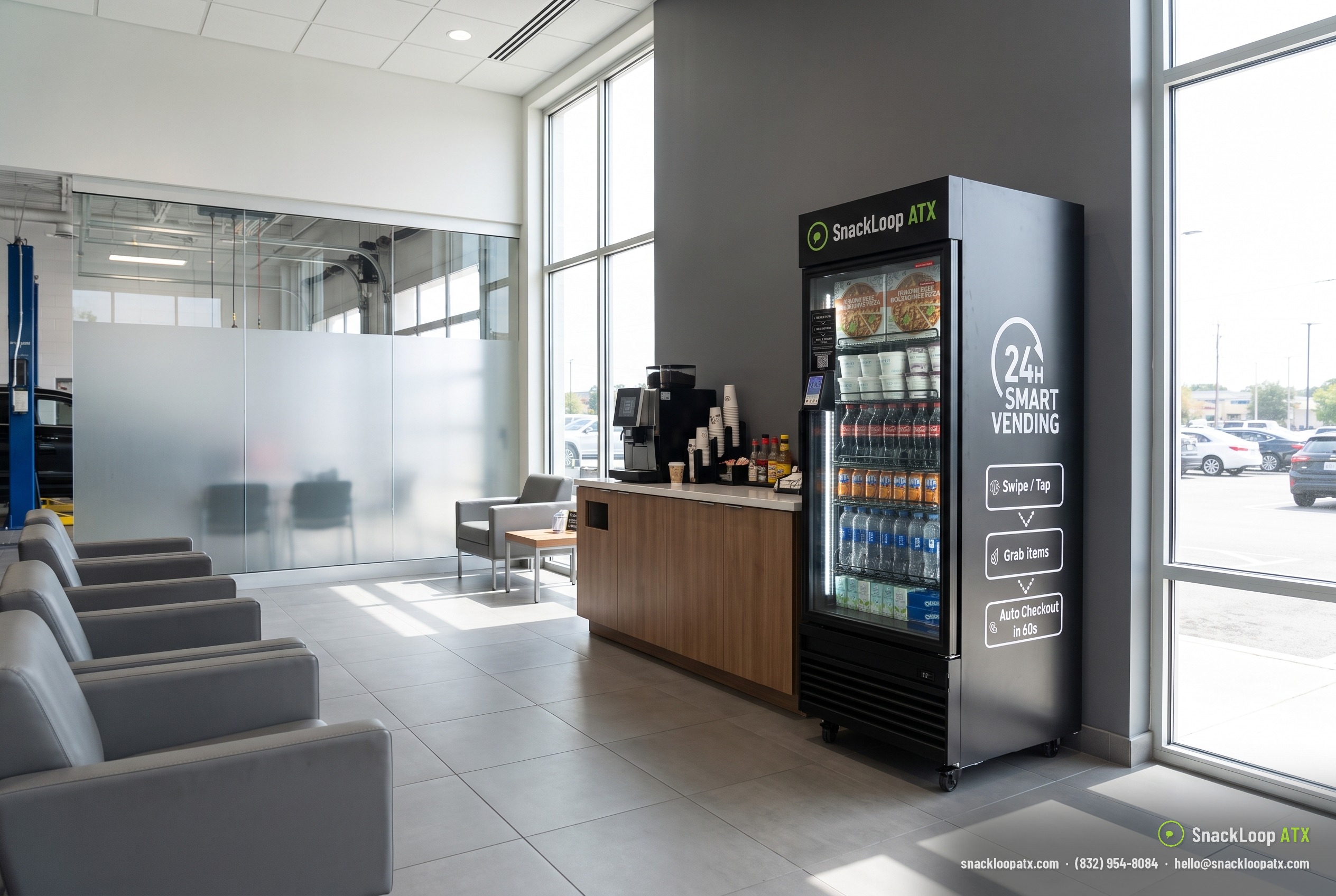
You do not need a study to answer this, and you should be skeptical of anyone offering one for a building they have never walked through. Three observations decide it, and all three are visible from inside your own site.
What are the three observations that decide it?
How many people are genuinely in the building, how easy it is for them to buy something else, and whether anybody there is stuck.
Everything else (square footage, the org chart, the industry) is a proxy for one of those three, and usually a poor one. A site can look small and still work because nobody can leave it, or look busy and still disappoint because there is a coffee bar in the lobby.
Here is the walk, in the order that makes it quick:
- Pick an ordinary day. Not the all-hands, not a holiday week. The machine has to live on ordinary days.
- Stand where people already stop: the breakroom, the time clock, the front desk, the waiting area. Count who actually passes.
- Check whether the site runs shifts, and what is open near the building at the hour your last crew leaves.
- Walk to the nearest place somebody could buy a cold drink, and time the round trip yourself. A map does not know about the gate, the stairs or the parking lot.
- Ask who cannot leave: the customer whose car is on a lift, the patient waiting to be called, the person who cannot walk away from a register.
- Look at the wall you would use. A standard power outlet within reach, room for the door to open fully, clear of forklift routes, carts and doorways.
- Note anybody who would not use a card-only machine, because these take a card or contactless tap and have no coin mechanism.
Give it one unhurried pass and write the answers down. The rest of this article is what they mean.
How many people are genuinely in the building on an ordinary day?
Not the payroll figure, and not the number of desks.
Hybrid schedules mean the number on the org chart and the number in the breakroom are often different, and the machine only ever meets the second one. The same gap shows up elsewhere: part-time retail staffing, providers who rotate between two clinics, a school roster with people off-campus at lunch.
Then check for shifts, because shifts stack and this is the part most people underestimate. A single crew of 60 is 60 people passing the machine. Three crews of 20 is also 60, but spread across the whole day, at hours when the building is otherwise quiet. That is the arithmetic behind why the same machine sells differently in a warehouse than in an office, and it belongs in the survey, not in a footnote.
How easy is it for them to buy something somewhere else?
Walk it, and time the whole round trip rather than the distance.
This is the one worth answering by looking rather than from memory. Somewhere close in a straight line may sit behind a locked gate, up a flight of stairs, or across a parking lot with no shade. In an Austin August, an unshaded parking lot is an obstacle rather than a detail. What matters is not the distance. It is how much of a break the trip consumes.
Do the walk at the hour that matters, too. What is open downtown in the afternoon and what is open at two in the morning out toward Pflugerville or Round Rock are separate questions. Check the second for your own address rather than assuming it, because it decides whether a night crew has an alternative at all.
Is anybody stuck waiting or working with no alternative?
This is the observation that can overturn a verdict reached on headcount alone.
A captive stretch beats a crowd with options. Somebody whose car is on a lift is not walking anywhere until it comes down; a patient called through to a waiting area cannot leave and keep their place; a cashier alone on a register cannot step off the floor for a cold drink. None of them is choosing your machine over an alternative, because there is no alternative to choose against.
That is why a modest service lounge is worth surveying rather than dismissing, which is the point behind an auto shop having two separate buyers for one machine. Dwell time does what headcount cannot.
How do the three answers read in your kind of building?
Differently, and the venue tells you which of the three to weigh hardest.
| Venue | What to look at first | What the answer tells you |
|---|---|---|
| Office | Desks occupied on an ordinary day, and the walk to the nearest coffee spot | The org chart and the breakroom hold different numbers under hybrid schedules |
| Warehouse or distribution center | Whether there is a second or third shift, and what is open at that hour | Shifts stack the count, and check what is open near the building when the late crew is on |
| Auto shop or dealership service | The real interval between handing over the keys and getting them back | A customer whose car is on a lift has nothing to compare your machine against |
| Gym | Whether the schedule has genuine peaks: class end times, the after-work hours | Many members arrive carrying their own bottle, so only the gaps in what they brought are left |
| Apartment community | Whether anybody stays in the common areas rather than passing through | Every resident has a kitchen upstairs, so the machine competes with going home |
| Medical clinic | How long patients and the people with them sit before they are called | Someone waiting to be called cannot leave the building to look for a drink |
| 55+ community | How many days a week something is scheduled in the clubhouse | There is no commute or shift here, so the calendar is what puts people in the room |
| School staff room | Whether staff can leave the site during the working day | A closed campus removes the alternatives for everyone on it, all day |
| Retail | Whether customers linger, and whether staff can step away from the register | Staff tied to a register are a captive group even when the customers are not |
Read across the row rather than looking for a verdict at the end. Two strong answers can carry a weak third. Three weak answers are a reason to say no before anything is installed. That is better for you than a machine standing unused in a corner.
What happens if the walk says yes?
Then the practical side is short, and most of it is not yours.
We deliver and install the machine, stock it, restock it on a regular schedule, and service and repair it at our own cost. You provide the floor space and a standard power outlet. Nobody on your side orders product, counts inventory, handles money or calls a technician. Every purchase is a card or contactless tap with automatic checkout in about 60 seconds. There is no cash, no coin mechanism and no keypad codes, and no long-term lock-in.
Placement terms depend on the location. Which one applies is settled before installation rather than after. If you want us to walk the site with you, the application form is on the home page.
And if the walk mostly confirmed that the machine you already have is the problem (half-empty at the wrong hour, or serving the wrong side of the building), that is a service question, not a location one, and we cover it in switching vending providers without a gap in service.
Do the walk first, though. Count who is really there, time the trip to the nearest alternative, and find out who cannot leave.
Frequently asked questions
How do I know if my location is big enough for a vending machine?
Size is the wrong starting point. Count the people who are genuinely in the building on an ordinary day, walk to the nearest place they could buy a cold drink and time it, then note whether anybody is stuck waiting. A small site where nobody can leave can work where a larger one next to a cafe does not.
Does this checklist work for a clinic or an apartment community too?
Yes, because the three questions do not assume a workplace. In a clinic the answer to look at is the wait before people are called. In an apartment community it is whether anyone stays in the common areas, since every resident has a kitchen upstairs and the machine competes with going home rather than with hunger.
What if the three answers point in different directions?
That is the normal result, and it is still useful. A weak count with a long walk to anything else and a captive audience is a different proposition from a strong count next to a food hall. Write all three answers down rather than averaging them, and raise the weak one at the survey instead of hoping it resolves itself.
What does it cost to host a machine, and do I get paid?
Hosting costs nothing. We deliver, install, stock, restock on a regular schedule, and service and repair the machine at our own cost, and you provide floor space and a standard power outlet. Terms vary by location and they are agreed before installation.
How do people pay, and what happens if the machine breaks?
Payment is a card or contactless tap at the machine, with no cash, no coin mechanism and no keypad codes, and checkout completes automatically in about 60 seconds. If the machine develops a fault we service and repair it at our own cost, since it is our equipment. There is no long-term lock-in on the placement.